

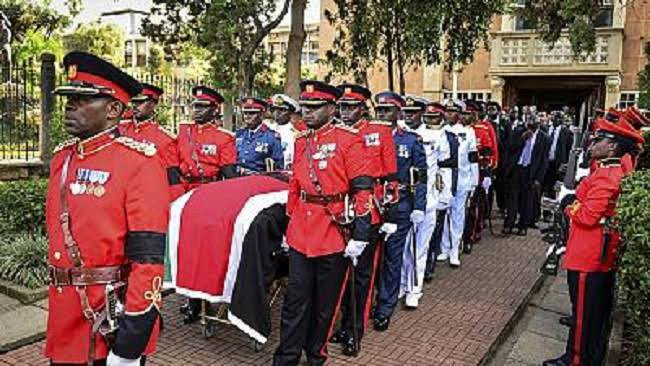
Jomo Kenyatta, Kenya’s first President, passed away on August 22, 1978. His funeral was a major national event, reflecting his significant role in the country’s history and its transition to independence. Kenyatta was buried at his home in Gatundu, which is now part of Kiambu County. However, just three months after his burial, a significant and controversial event took place regarding his remains.
In November 1978, only three months after his burial, Kenyatta’s body was exhumed. This action was part of a broader, politically charged move by his successor, President Daniel arap Moi, who had come into power following Kenyatta’s death. The exhumation was conducted to re-bury Kenyatta’s remains at a more prominent location—at the Uhuru Park mausoleum in Nairobi, a site that was intended to honor Kenyatta’s legacy and establish his final resting place as a national monument.
The decision to move Kenyatta’s remains was influenced by several factors:
- Political Symbolism
Relocating Kenyatta’s body to a more prominent and central location in Nairobi was intended to underscore his enduring significance in Kenya’s history. It was seen as a way to consolidate national unity and strengthen the new administration’s connection to Kenyatta’s legacy.
- National Unity and Reverence
By re-burying Kenyatta in a national monument, the government aimed to reinforce his status as the father of the nation. Uhuru Park, being a central and symbolic location, was chosen to emphasize his foundational role in the country’s independence and unity.
- Reaffirmation of Leadership
The move also served to solidify President Moi’s leadership. By undertaking this significant act, Moi was able to align himself more closely with Kenyatta’s legacy, thus legitimizing his own position as the new leader of Kenya.
The exhumation and reburial of Jomo Kenyatta’s body were both a political statement and a ceremonial gesture. It was an effort to honor his memory in a way that reflected the changing dynamics of Kenyan politics and leadership. The event highlighted how political leaders often use symbolic acts to reinforce their authority and connect with historical legacies.
By the Citizen