

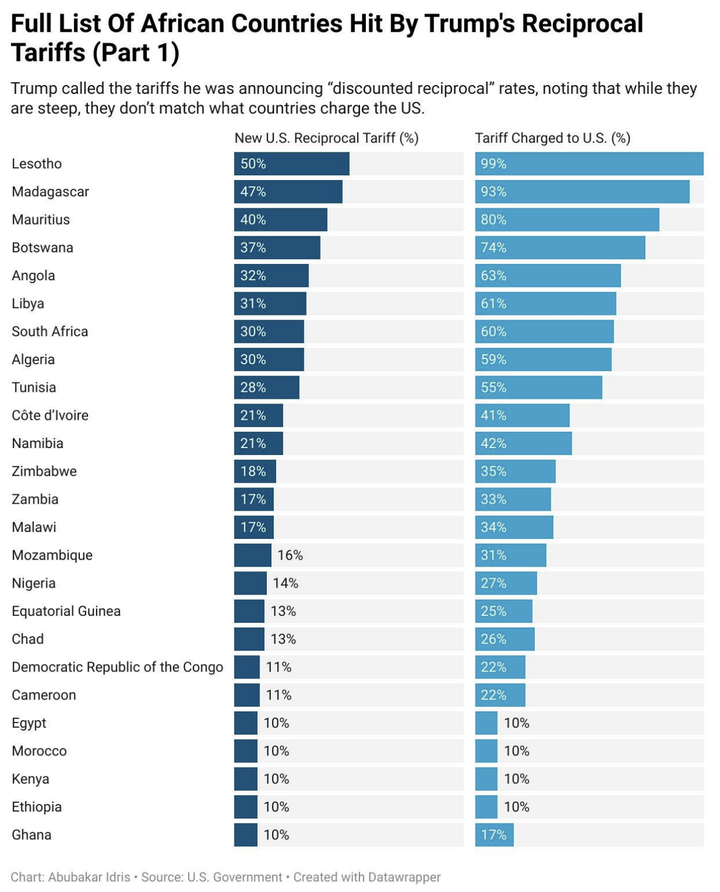
On Thursday, Kenyans woke up to the news of U.S. President Donald Trump’s imposition of a 10% tariff on all imports from Kenya, a move described as part of a broader strategy to address perceived trade imbalances and protect American economic interests.
President Trump unveiled these tariffs during a “Liberation Day” event at the White House Rose Garden, stating that the tariffs aim to level the playing field in international trade and counter what he described as “cheating” by foreign nations.
The newly imposed tariffs are expected to affect Kenyan exports to the U.S., which totalled $737.3 million in 2024.
Key sectors such as apparel, coffee, and tea, which have previously benefited from duty-free access under the African Growth and Opportunity Act (AGOA), are likely to be the most impacted.
However, the move could end up being a blessing in disguise if planned government countermeasures are anything to go by. Trump’s decision could be a catalyst for Kenya to reposition itself strategically in the global market,
First, since AGOA is set to expire in September 2025, the tariff might not take effect immediately, which could be a major relief, as Foreign Affairs PS Korir Sing’Oei explains.
“While the tariffs may be one of the lowest, we shall be vigorously advocating for their waiver. Additionally, as AGOA is a Congressional framework for market access to the US by African exporters, it is our considered view that until the law lapses end of September 2025 or unless repealed earlier by Congress, the new tariffs imposed by President Trump will in any event still not be immediately applicable,” Sing’Oei notes.
Competitive Edge
Though Kenyan businesses now face a costlier export process to the U.S., the tariff rate remains significantly lower than those imposed on other key textile-exporting nations such as Vietnam (46%), Sri Lanka (44%), Bangladesh (37%), China (34%), Pakistan (29%), and India (26%).
This discrepancy presents Kenya with a golden opportunity to carve out a competitive niche in the global supply chain. Investment, Trade and Industry CS Lee Kinyanjui sees this as a perfect opportunity for the country to position itself as an option for U.S. buyers seeking cost-effective alternatives.
Opportunities in the Textile Sector
One of the most promising avenues for Kenya lies in its textile industry. With many traditional textile powerhouses facing much higher tariffs, buyers will likely seek alternative sourcing options.
Kenya can therefore position itself as a reliable sourcing hub for apparel and related goods. By investing in local textile production and value addition—such as spinning, weaving, and finishing—Kenya can offer a compelling alternative to pricier imports from Asia.
According to the CS, the government is already working on an export enhancement plan through the Ministry of Investments, Trade, and Industry (MITI) and the Ministry of Foreign Affairs (MFA).
Encouraging local production and value addition—such as spinning, weaving, and finishing—could make Kenya an attractive alternative to Asian exporters.
Additionally, private sector investment in modern textile manufacturing facilities and workforce training could significantly enhance Kenya’s ability to absorb new demand, creating employment opportunities while strengthening the economy.
Diversification Beyond Textiles
The tariff change further provides an opening for Kenya to diversify its export base. Higher tariffs on competitors mean increased costs for U.S. buyers, presenting Kenya with an opportunity to expand into sectors such as leather goods and agro-processing.
Kenya’s strong agricultural sector, particularly in coffee, tea, and horticulture, could benefit from value addition before export.
By processing these products locally, Kenya can command higher margins and increase its attractiveness in international markets. This diversification reduces the country’s reliance on a few key exports, a long-standing economic vulnerability.
The 10% tariff, while lower than those imposed on competitors, still raises costs for Kenyan exporters, potentially squeezing profit margins in the short term.
CS Kinyanjui notes that other necessary measures, such as expanding production capacity to meet new market opportunities, will require significant investment in supply chains, infrastructure, and workforce development.
“The Ministry is committed to managing this transition with Kenya’s best interest at heart. We will continue engaging stakeholders, strengthening partnerships and implementing policies to support sustainable trade growths and economic resilience,” he indicates.
Kenyan is among the African countries hit with the lowest tariffs, with others such as Lesotho getting as high as 50%.
Globally, the country isn’t also badly off. The worst affected are Cambodia at 49 and Vietnam at 46%.
By Nairobi