

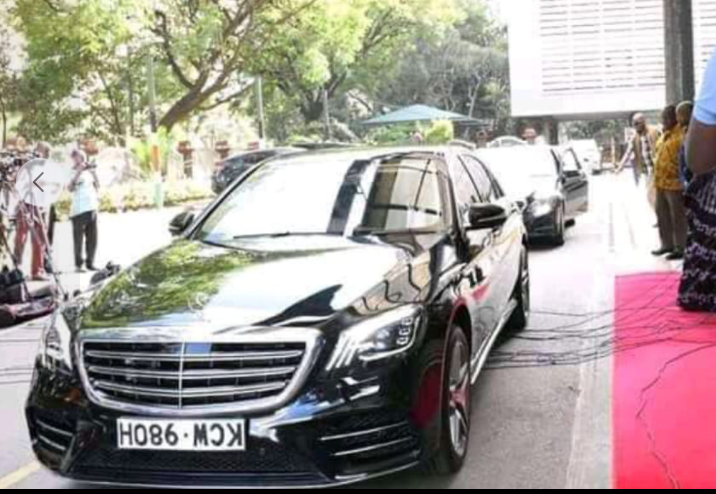
In Kenya, vehicle number plates are official identifiers issued by the National Transport and Safety Authority (NTSA) to uniquely identify motor vehicles and link them to their owners.
They serve as a legal requirement for all road vehicles, including cars, motorcycles, and trailers, and convey specific information about the vehicle’s type, ownership, and purpose through their color, format, and codes.
On March 15, 2020, Formrr President Uhuru Kenyatta arrived at Harambee House in Nairobi to address the nation about the coronavirus pandemic.
His car’s front number plate was fixed upside down, reading “H086 MƆʞ” instead of “KCW 980H,” which sparked widespread speculation among Kenyans. The rear plate was correctly oriented, and the car lacked the presidential flag and aide-de-camp, further fueling discussion.
Two main theories emerged online and in media. Some claimed it was a deliberate act, citing two reasons:
1. First, that an upside-down number plate is a standard procedure when the presidential vehicle lacks the national flag; second, that it signals the head of state is delivering bad news, such as the confirmation of two additional COVID-19 cases and measures like school closures and work-from-home directives.
Others suggested it was a security tactic or a symbolic gesture reflecting national distress, with some even linking it to European practices where prominent figures use inverted plates for uniqueness.
However, a senior government official, speaking anonymously to Nairobi News and Citizen Digital, dismissed these theories, stating the inversion was a mistake with no basis in military protocol. They noted that if it were intentional, both front and back plates would have been inverted, and no such precedent exists globally. The mistake was reportedly rectified quickly.
Public reactions on social media ranged from criticism of government incompetence to humorous remarks about “confusing the virus” or security maneuvers. While some saw it as a metaphor for a nation “moving in the wrong direction,” others viewed it as an oversight by the president’s team during a chaotic time.
In conclusion, despite speculation about symbolic or procedural significance, the upside-down number plate was likely an error, not a deliberate act with deeper meaning.
By YouthVillage