

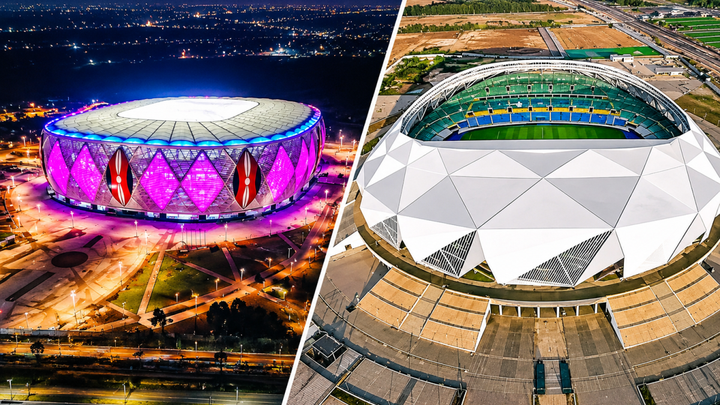
As Kenya and Tanzania prepare to co-host the 2027 Africa Cup of Nations alongside Uganda, the two neighbours are racing to deliver new sporting landmarks that will define their hosting ambitions.
Among the most talked-about projects are Kenya’s Raila Odinga International Stadium in Nairobi and Tanzania’s Samia Suluhu Hassan Stadium in Arusha.
Both are being built as modern football facilities ahead of AFCON 2027, but there is a substantial difference in their cost, seating capacity and intended use.
The price difference
The Samia Suluhu Hassan Stadium in Arusha has become one of Tanzania’s most expensive new sports infrastructure projects.
The project was initially announced at about Tsh286 billion, but the figure has since risen to Tsh338.54 billion. Tanzania’s Government Spokesperson Gerson Msigwa said the increase was linked to changes required to bring the facility up to CAF Category 4 standards after Tanzania secured the right to host AFCON matches.
Using the Kenya Revenue Authority’s exchange rate for the week of November 23-29, 2026, of Tsh20.44 to the Kenyan shilling, the Tsh338.54 billion project translates to approximately Ksh16.56 billion.
The Raila Odinga International Stadium, formerly known as Talanta Stadium, carries a significantly higher price tag.
Its contract value stands at approximately Ksh45.848 billion, after rising from an initial estimate of about Ksh35 billion. The government has attributed the increase to taxes, levies, freight and clearing costs associated with the construction contract, although the Auditor-General has questioned the documentation supporting the KSh10.848 billion variation.
This means Raila Odinga International is about Ksh29.3 billion more expensive than the Samia Suluhu Hassan Stadium based on the latest reported figures.
Put another way, the Nairobi project costs roughly 2.8 times as much as the Arusha stadium.
Capacity: Raila Odinga Stadium takes the lead
The biggest difference between the two venues is their seating capacity.
The Samia Suluhu Hassan Stadium is designed to accommodate about 30,000 spectators, although some recent Tanzanian reports have referred to a 32,500-seat configuration.
The Raila Odinga International Stadium has a capacity of 60,000, effectively giving it twice the seating capacity of its Tanzanian counterpart.
That gives the Nairobi stadium an advantage when it comes to hosting major international football fixtures, particularly high-profile AFCON matches where demand for tickets is expected to be high.
The 60,000-capacity venue is also expected to host the opening of its new era with a blockbuster friendly between Bayern Munich and Ajax on January 5, 2027.
What does Samia Suluhu Stadium offer?
The Arusha stadium has been conceived as more than simply a football ground.
Tanzania’s authorities say the facility will include VIP areas, offices, halls and a museum, while the stadium is also expected to support athletics, trade events and other major gatherings.
Its architectural identity is another major feature.
The design incorporates elements inspired by Tanzanite, the precious gemstone strongly associated with the Arusha region, as well as Mount Kilimanjaro. The distinctive design is intended to give the stadium a recognisable Tanzanian identity while also serving as a tourism attraction.
The stadium is being constructed by China Railway Construction Engineering Group, with the project expected to meet international requirements for major football competitions. Tanzania says the additional expenditure was partly driven by the need to meet CAF Category 4 requirements, including improved playing surfaces, dressing rooms, security arrangements, floodlighting, backup power and media facilities.
What makes Raila Odinga International different?
Kenya’s stadium has been designed primarily around football and rugby rather than athletics.
The facility has a 60,000-seat capacity, covered spectator stands, a large roof canopy, two training pitches, VIP and hospitality areas, media facilities and a hybrid playing surface combining natural grass with stitched synthetic fibres. It also has 52 luxury skyboxes and premium seating areas.
The wider Talanta Sports City complex includes additional training facilities, parking and other infrastructure.
The stadium has also been fitted with giant LED screens, LED ring lights, a modern sound system and turnstiles designed to improve security and crowd management. Lifts and other accessibility infrastructure are part of the development.
A musical aquatic fountain and façade lighting are also part of the wider project, adding an entertainment and commercial dimension to the facility.
Which stadium gives more for the money?
On the face of the reported figures, the comparison produces an interesting result.
The Samia Suluhu Hassan Stadium costs about Ksh16.56 billion and offers roughly 30,000 seats.
Raila Odinga International costs about Ksh45.85 billion for 60,000 seats.
Based purely on construction cost and seating capacity, the Arusha stadium works out at roughly Ksh552,000 per seat, compared with approximately Ksh764,000 per seat for the Nairobi facility.
That does not necessarily mean the Tanzanian project offers better value for money. The two projects have different designs, specifications, supporting infrastructure and cost structures, while the reported figures may cover different scopes of work.
The Nairobi project also incorporates a much larger capacity, extensive hospitality facilities, training grounds and a sizeable wider sports complex.
The bigger AFCON picture
The two stadiums will serve different strategic purposes during AFCON 2027.
Arusha gives Tanzania a new international-standard venue in the country’s northern tourism circuit, close to attractions such as Mount Kilimanjaro and the Serengeti. Its presence could therefore combine football with Tanzania’s wider tourism ambitions.
Nairobi’s Raila Odinga International Stadium, meanwhile, is intended to be Kenya’s flagship AFCON venue. It is the country’s largest new stadium and is expected to host some of the tournament’s biggest matches.
The difference also reflects the two countries’ hosting arrangements. Tanzania has three AFCON host cities, while Kenya’s matches are concentrated in Nairobi. The Raila Odinga International Stadium therefore carries an especially heavy responsibility for Kenya’s tournament presentation.