

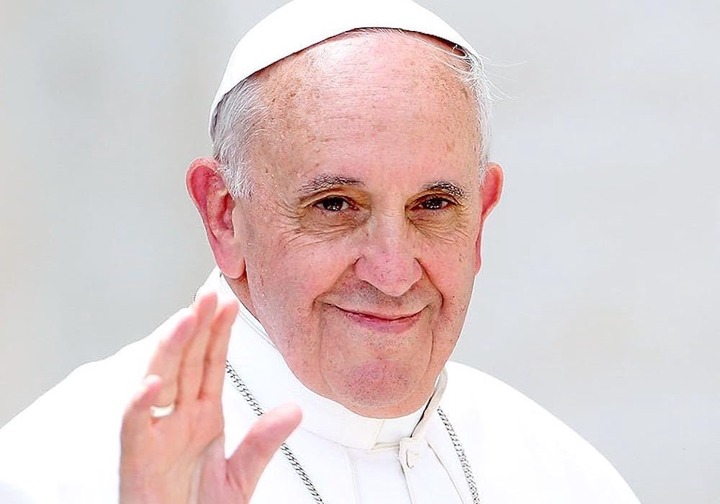
Before going to sleep on June 7, 2018, Pope Francis wrote down an experience that left him shaken.
In a handwritten entry from his private black plastic planner, the late pontiff described a terrifying vision of evil, and the simple way he fought it off.
“Last night I saw the entrance to Hell. Pagan seduction in full force,” Francis wrote. “I peeked in to look a little, and it terrified me. It was before going to sleep. I grabbed the rosary as a weapon. I thank the Lord for this help. Prayer alone makes room for the Lord to save us.”
The entry appears in The Private Diary of Pope Francis, released globally on November 24, 2026, in five languages across 94 countries.
Curated by his longtime friend and theological aide, Cardinal Víctor Manuel Fernández, and approved for publication by Pope Leo XIV after Francis died on April 21, 2025, the book brings together handwritten reflections spanning from December 1992 in Buenos Aires to August 2024 in the Vatican.
Only Francis’s most confidential passages, written in a personal symbol code nobody can decipher, were left out.
Fighting back with the rosary
Francis wrote the “pagan seduction” passage during one of the darkest stretches of his papacy, just days after 34 Chilean bishops submitted their resignations following a Vatican investigation into clerical sexual abuse.
He admitted that the lure felt “voracious” and dangerous: “Pagan seduction is strong but closed in on itself. It has no future; there’s no room for hope in it. Its brightness is blinding, and nothing else matters.”
It was not the only time he turned to the rosary when he felt spiritually cornered. In a January 2021 entry, Francis recounted three separate moments when he believed the devil was “physically present.”
Twice as archbishop of Buenos Aires, he saw what he called “menacing and, at the same time, seductive eyes” – once from a car, and again in the choir loft of the Chapel of Carmel, where he escaped by clasping his rosary and praying to the Virgin Mary.
The third encounter came in Rome days after his troubled 2018 trip to Chile. Sitting in a meeting, Francis wrote that he heard a raspy, triumphant voice declare: “Now I’ve gotten everything I wanted.”
According to Cardinal Fernández, Francis later explained that the devil’s sharpest weapon against leaders is not crude malice, but what the pope called “reductive curiosity” – a hidden craving to feel omnipotent, “to be like God,” and to treat other people “like puppets.”
That inner battle peaked during a grueling two-year spiritual crisis in 2021 and 2022 as his health declined and resistance to his reforms on governance and women leadership in the Vatican intensified.
A leader afraid of the job
Those spiritual battles ran alongside deep, ordinary doubts about whether he could carry the papacy at all. In public, Francis projected calm after his March 2013 election; on paper, his initial reaction was strikingly sparse.
The day after Pope Benedict XVI stepped down, Francis wrote on February 12, 2013: “Yesterday the Pope resigned.” Four months into his own pontificate, his July 2013 note read simply: “They elected me pope on 13 March.”
Behind that restraint sat genuine fear. Across his private notes, Francis wrote “I am afraid”, questioned whether he was equal to the role, worried he might cause “harm”, and even asked God to take him “away”.
Brutal honesty on the page
Francis was just as unforgiving with himself in quieter moments. On January 15, 2017, he admitted that “for the past three or four days, I’ve been really angry and upset”.
On December 30, 2022, he turned the lens squarely on his own ego, calling out “The arrogant, self-sufficient, cynical Jorge who lies to himself”.
Elsewhere, he confessed to wrestling with “disdain, envy, pride” and recorded his guilt after walking past a drunk man who tried to speak to him on the street “because I wanted to walk in peace and quiet”.
Psychology helps explain why private pages often become a lifeline for leaders under pressure.
A 2018 peer-reviewed study in Acta Bio Medica examining expressive writing among high-stress caregivers found that “People begin to interact differently with others and see themselves in a new light after writing about an emotional subject.”
The reform he held back
Alongside the book’s release, Cardinal Fernández disclosed one major change Francis wanted to enact but ultimately left untouched: allowing married men to be ordained as priests.
“He wanted to take this decision. But he wanted to avoid internal battles, verbal violence,” Fernández said. “When we prepared the document to allow blessings for same-sex couples, there was a very harsh reaction.”
Private grace for critics, his successor, and a silence at Fatima
For all his anguish over church divisions, Francis’s private assessments of his fiercest public critics were surprisingly warm.
According to Fernández, he wrote that Guinean Cardinal Robert Sarah possessed “a refined spiritual sensitivity”, and that German Cardinal Gerhard Müller “seems aggressive, but he’s a good man”.
Long before the May 8, 2025 conclave elected Robert Prevost as Pope Leo XIV, Francis also left a glowing verdict on his future successor, describing him as “a great pastor, a generous missionary, and an irreproachable man”.
The diary even settles a quiet mystery from World Youth Day 2023 in Portugal, where pilgrims watched Francis stand silently before the Virgin of Fatima without reciting a prepared prayer.
In an October 2023 entry, Francis explained it in four words: “I gazed and prayed” adding the next day, “I looked at her and she spoke to me.”
Fernández said the published pages were chosen to “bring some edification to readers,” leaving behind an unvarnished portrait of a pope who wrestled with temptation, fear, and ego long after the cameras left the room.