

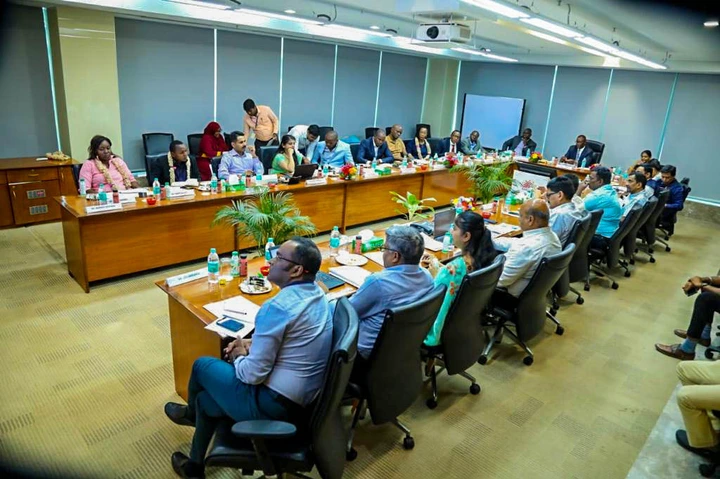
Information, Communication, Technology & the Digital Economy Cabinet Secretary Eliud Owalo led a Kenyan delegation for a benchmarking visit to the headquarters of India’s Unique Identification Authority (UIDAI), the statutory body responsible for India’s digital identity (AADHAAR).
AADHAAR is an open source unique lifetime, biometric-based identity. UIDAI was created to issue Unique Identification numbers (UID), named as “Aadhaar”, to all residents of India.
The UID had to be robust enough to eliminate duplicate and fake identities, verifiable and authenticable in an easy cost-effective way.
The unique identification project was conceived as an initiative that would provide identification for each resident across India and would be used primarily as the basis for efficient delivery of welfare services.
The delegation held detailed discussions that entailed the Legal instruments and the Policy framework on which AADHAAR is anchored, plus the Risk Mitigation framework to ensure both data privacy and security.
The Unique Identification Authority of India (UIDAI) is a statutory authority established under the provisions of the Aadhaar (Targeted Delivery of Financial and Other Subsidies, Benefits and Services) Act, 2016 (“Aadhaar Act 2016”) on 12 July 2016 by the Government of India, under the Ministry of Electronics and Information Technology (MeitY).
UIDAI was created with the objective to issue Unique Identification numbers (UID), named as “Aadhaar”, to all residents of India that is (a) robust enough to eliminate duplicate and fake identities, and (b) can be verified and authenticated in an easy, cost-effective way.
The first UID number was issued on 29 September 2010 to a resident of Nandurbar, Maharashtra. The Authority has so far issued more than 111 crore Aadhaar numbers to the residents of India.
Under the Aadhaar Act 2016, UIDAI is responsible for Aadhaar enrolment and authentication, including operation and management of all stages of Aadhaar life cycle, developing the policy, procedure and system for issuing Aadhaar numbers to individuals and perform authentication and also required to ensure the security of identity information and authentication records of individuals.
The Kenyan delegation on Wednesday were also taken through a familiarisation tour of the Unique Identification Authority ( UIDAI) facility, including but not limited to elaborate demonstrations.
The UIDAI team was led by Ms. Tanusree Deb Barma, the Deputy Director General (Technology development) and Ms. Annie Joyce, Deputy Director General (Technical Operations).
Present were Kenya’s High Commissioner to India Willy Bett, Mr. Anish Kumar of India’s Minsitry of External Affairs and officials from Kenya’s Ministry of ICT and The Digital Economy, KONZA Technopolis and ICT Authority.
by: SadiqSaad