

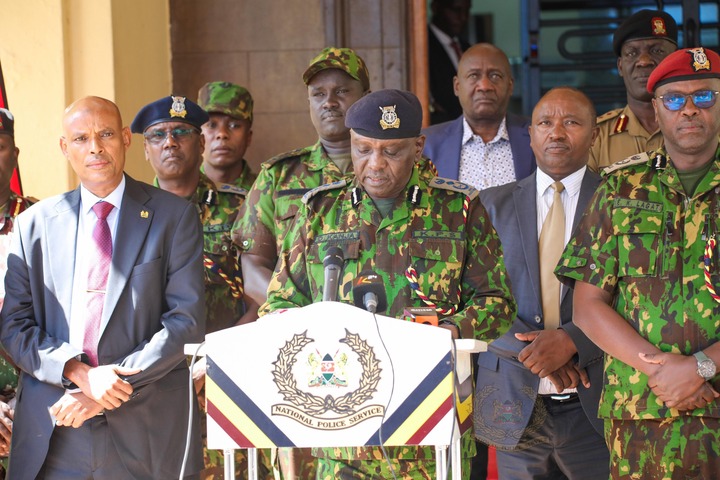
A simmering dispute between the National Police Service Commission (NPSC) and the Office of the Inspector General of Police has escalated to Parliament, with MPs now set to interrogate the matter.
Inspector General Douglas Kanja has been summoned to appear before the Constitutional Implementation Oversight Committee (CIOC) to clarify his position on the ongoing turf wars.
The standoff, which has been brewing for months, revolves around overlapping roles and responsibilities between the two key security institutions.
While the Constitution grants the NPSC powers to handle recruitment, promotions, and disciplinary matters within the police service, the IG maintains operational command and control over officers.
The friction arises where these mandates intersect, particularly in decision-making on transfers, assignments, and accountability.
According to sources within Parliament, CIOC members are concerned that the continued clashes risk undermining the effectiveness of the country’s security apparatus.
The committee, chaired by experienced legislators, will meet at Parliament Buildings on the fifth floor to deliberate on the crisis.
IG Kanja is expected to explain his office’s position, while MPs will seek to understand why coordination between the NPSC and police headquarters remains elusive more than a decade since the constitutional reforms restructured the security sector.
Analysts argue that the problem stems from ambiguities in the Constitution and subsequent laws that failed to provide a seamless division of responsibilities.
In practice, this has led to instances where the NPSC and the IG issue conflicting directives, creating confusion within the police service. For example, while the commission may recommend disciplinary action against an officer, the IG retains operational authority to deploy or reassign the same officer—often leading to friction.
The government is now under pressure to broker an amicable solution. Civil society organizations have urged both parties to prioritize national security over institutional pride.
Parliament’s intervention signals recognition that the stalemate cannot be left to fester. Lawmakers are considering recommendations that could either lead to legislative amendments or policy guidelines clarifying the boundaries of each office.
Already, some MPs have suggested that the Executive should step in to mediate and establish a clear framework for cooperation.
As the IG prepares to face CIOC, the spotlight is firmly on how he will defend his office’s stance without aggravating tensions with the commission. His testimony is expected to shape Parliament’s final position and possibly chart a new path for police governance.
The outcome of the meeting could have far-reaching implications, not only for the working relationship between the IG and NPSC but also for the broader question of accountability and efficiency in Kenya’s security institutions.
By Nairobi