

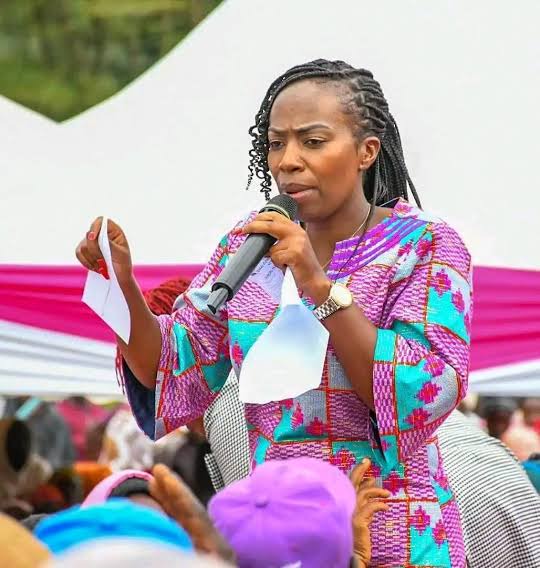
Betty Maina has launched a fiery response to former Deputy President Rigathi Gachagua after he allegedly weighed in on her marriage, turning a political exchange into a highly personal confrontation.
In a strongly worded statement, Maina questioned why Gachagua would openly discuss her marriage and claimed that the former Deputy President had previously expressed doubts about the relationship.
“Your inability to feel ashamed discussing my marriage publicly?” Maina posed, directly addressing Gachagua.
She further claimed that Gachagua had conducted what he described as due diligence into her background before the marriage, but that Mathira MP Eric Wamumbi chose to ignore his concerns.
Maina, however, dismissed any suggestion that her marriage was in trouble, insisting that she and her husband are happy together and have built a strong relationship despite predictions that their union would not last.
“We are happy together, we have achieved a lot together, we understand each other and we are crazy together,” she stated.
According to Maina, Gachagua had previously predicted that the marriage would collapse within six months.
She attributed the survival of their relationship to divine intervention, sarcastically saying that “God does not listen to male witches.”
Her remarks appeared to escalate the personal nature of the exchange, as she accused the former Deputy President of interfering in matters that she believes should remain private.
Maina also dragged Keith and Ikinu into the controversy, suggesting that excessive interference and unsolicited opinions could be among the reasons the two have not married.
She sarcastically suggested that Gachagua’s tendency to involve himself in other people’s affairs could be a “barrier” to their relationships.
The outspoken response ended with another sharp reference to Gachagua, whom Maina compared to “the male adult version of Fatuma,” a character associated with being subjected to the pulling of ears by a jini.
Maina’s statement has since added a new dimension to the increasingly heated political and personal exchanges surrounding Gachagua and his critics.
While political disagreements are common, her remarks highlight how Kenya’s political battles can sometimes spill beyond policy and ideology into deeply personal territory.
The exchange is likely to attract further attention, particularly because it touches on marriage, family and private relationships subjects that rarely remain outside the spotlight once prominent political figures become involved.
For Maina, however, the message was clear: whatever predictions may have been made about her marriage, she insists that the union has endured and that she and her partner remain happy together.