

At 81 years, Peter Nzioka should be spending his sunset days in bliss, enjoying the company of his grandchildren and revelling in the memories of the days gone by.
But he isn’t. Nzioka has no reliable source of income.
A resident of a Sofia slum in Athi River, Machakos County, the senior citizen sometimes worries about his eight children, 19 grandchildren and four great-grandchildren.
Other than volunteering as a Nyumba Kumi elder at the Athi River Township assistant chief’s office, Nzioka has no source of livelihood. The Sh2,000 monthly stipend he receives from the government keeps him going.
“Inua Jamii helps the elderly like myself a lot. I have benefited from the state fund since its inception,” he said.
Though the amount is small, it settles some of his bills and pays for his basic needs.
“I use the money to buy basics like maize flour, sugar, cooking oil and soap. Inua Jamii is really helpful. I have a wife with eight children, 19 grandchildren and four great-grandchildren,” Nzioka said.
“We are grateful to the government. It should expand the programme to support as many elderly persons as possible.”
Nzioka is among 1,148,731 older persons aged 70 years and above enrolled in the government’s Inua Jamii social protection programme.
The number of beneficiaries has risen by more than 500,000 since the Kenya Kwanza administration came to power four years ago.
The state department for Social Protection estimates there are 1,413,430 eligible elders in 2026, meaning the Inua Jamii coverage is at 81 per cent of the target population.
“As Kenya’s population ages, many older people face declining incomes, rising healthcare costs and increasing dependence on family members,” Social Protection PS Joseph Motari said.
“The government’s Inua Jamii Older Persons Cash Transfer programme is designed to provide a safety net for Kenyans aged 70 and above by giving eligible beneficiaries regular financial support.”
Inua Jamii is anchored in the Constitution and the Kenya Social Protection Policy 2023.
“Article 43 of the Constitution recognises the right to social security, while Kenya’s Social Protection Policy 2023 explicitly provides for both contributory and non-contributory protection across the life cycle,” said Edwin Wanjawa, a governance and social policy analyst and lecturer at Pwani University.
Motari said Sh2,298,038,000 is disbursed monthly through M-Pesa.
“Elderly beneficiaries mainly use the cash transfer to buy food, medicine and other basic household needs. The transfer helps improve household food security, access to healthcare, and reduces dependence on family members,” the PS said.
Murang’a tops the list of beneficiaries at 62,176, followed by Kakamega (52,343), Kiambu (50, 414), Kitui (49,647), Meru (49,405), Machakos (49,165), Nakuru (46,958), Nyeri (38,308), Bungoma (37,127), and Siaya (36,371). Lamu County has the least at 3,299.
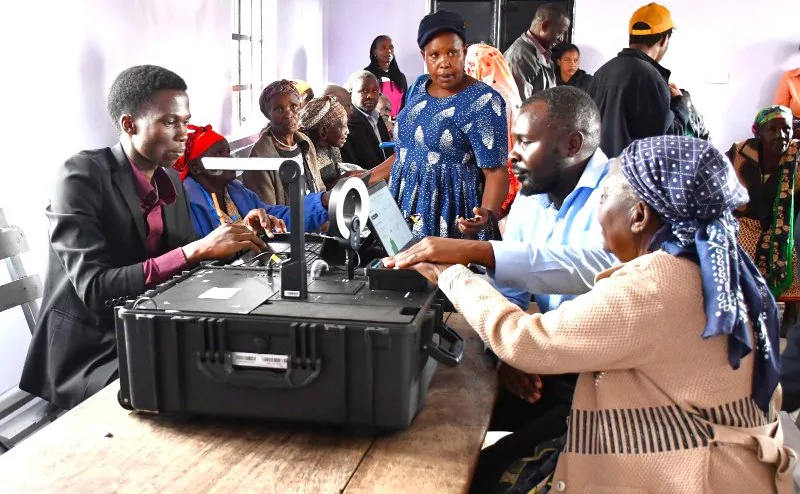
The targeting process identifies beneficiaries based on established eligibility criteria. Beneficiaries are identified at the village level by social protection officers in collaboration with national government administrative officers.
The applicant must have a valid national identification card and not in any government pension.
The government curbs fraud through ongoing proof of life, regular updating of beneficiary records, monitoring of payments and removal of deceased or ineligible beneficiaries.
“The government has undertaken impact evaluations of the Older Persons Cash Transfer programme, which provide evidence of its contribution to poverty reduction and improved financial wellbeing,” Motari said.
“The evidence indicates the programme has reduced poverty among households with older persons and improved their ability to meet basic needs.”
Inua Jamii has benefited thousands of senior citizens in the North Rift, but many more are still seeking enrolment.
Mzee Jamin Kibet from Nandi wishes the money would be increased from the current Sh2,000 monthly to enable him to cover most of his needs without relying on anyone else.
“Whenever that money comes, I usually feel energised because it enables me to buy the food I need or medicine. Without it, I would have suffered,” he said.
For most of the elders who have no other source of income and rely on support from their children or well-wishers, the Sh2,000 is small but life-changing.
Kipkorir Ng’etich from the Centre for Human Rights and Democracy in Eldoret said many of the elders go through a lot of suffering with no support to meet their needs, yet they have no energy to work for themselves.
President William Ruto’s commitment to strengthening the initiative is a major boost to the lives of senior citizens across the country, he said.
“We urge the President to look into ways of strengthening the Inua Jamii initiative because its impact on that large portion of our society is immense.”
Paul Njoroge from Kidiwa in Eldoret said the stipend helps him put food on the table and gives him dignity because he does not always have to cry out for help.
“I live alone because my children moved to other towns. When I receive cash, I don’t have to beg from neighbours or friends because it enables me to buy some food for myself,” he said.
Rosa Kitur, who is aged 73 and lives at Maili Nne in Eldoret, said she was enrolled a few years ago and has been receiving the money through her mobile phone.
“I still know how to operate my phone and when I receive the money, I usually walk to the nearby M-Pesa shop or even buy directly what I need. This is a very good initiative for us,” she said.
The main challenge for some of the elderly people has been reliance on third parties to access the money because of their inability to use mobile phones or bank accounts.
Sometimes they end up losing much of the money because of insincere parties who take advantage of their vulnerability.
Many of the elders in the region are grateful to the state for the Inua Jamii, which they urge should be expanded to cover all senior citizens and that the stipend should also be increased.
“It’s painful to age when you have no source of money and you have to rely on other people to survive every day. That money has really helped to restore my dignity,” Kitur said.
In Murang’a, Jeffrey Kuria lives with his wife on their two-acre farm in Mathioya. But the elderly couple is unable to undertake the hard physical labour required to support themselves.
“We are always waiting for the Sh2,000 to buy food and other essential items that we require,” Kuria said.
The 72-year-old man told the Star their lives would have been difficult without the stipend. They struggle when the government delays disbursing the funds, forcing them to incur debts.
“We would be very happy if the government consistently disbursed the funds every month so we can plan for it,” he said, lauding the government for supporting the elderly.
Caroline Kimatu said the stipend comes in handy for many elderly people suffering from chronic illnesses.
Kimatu suffers from arthritis, which has affected her fingers and made farming difficult.
During cold seasons, her condition becomes very painful and almost incapacitates her, leaving her dependent on medication.
“When this money comes in, my priority is the arthritis drugs, and whatever remains goes towards food,” she said.
Her children work in the informal sector in Nairobi and barely make ends meet.
Kimatu said the government should consider raising the stipend from Sh2,000 to at least Sh5,000 per month in line with the high cost of living.
Agnes Wanjiru, 75, said she last heard from her daughter last year.
“She brought me her son five years ago and has been sending me a little support, but since last year, I have not heard from her,” she said.
Wanjiru, who hails from Kambirwa in Kiharu constituency, said the stipend helps her educate her grandson but is not enough to meet all her needs.
She urged the government to stabilise the economy so that young people can find jobs.
“If my daughter had a stable job, she would be able to provide for her child, and I would only have myself to worry about,” she added.