

A regular pilgrim at the Subukia National Marian Shrine has shared an unusual account of what she believes are extraordinary occurrences at the Catholic pilgrimage site, including a claim that water taken from the shrine later appeared to have turned into blood.
Project to rehabilitate Subukia Shrine set to begin | Daily Nation
The woman spoke when YouTuber Paxson Chege Ngunya visited the shrine on Sunday, October 4, 2026.
She was among several female pilgrims who described personal experiences and stories they associate with the religious site.
She said her own visits had included witnessing what is commonly referred to by some pilgrims as the “dancing sun”.
According to her, such experiences are not necessarily the same for everyone who visits the shrine.
“I have witnessed the miracle of the dancing sun several times,” she said, explaining that what pilgrims experience may depend on their faith and relationship with God.
She added that some visitors may come to the shrine without seeing anything they consider miraculous, while others may have experiences they regard as extraordinary.
“Depending on how you relate and how your faith is, you can see different things, and you can hear very different things from people,” she said.
The woman then recounted a story she said she had heard from people who had visited the shrine and carried some of its water home.
She claimed that the water later changed in appearance and looked like blood.
She further said the pilgrims involved did not keep the matter to themselves but took the water to a bishop for examination.
“And I know people who have been here and taken away some of the holy water from here, and later on that water turned into blood,” she said.
According to her account, the bishop subsequently confirmed what the pilgrims had brought to him.
Environment degradation imperils Kenya’s Subukia Shrine and healing waters | National Catholic Reporter
She claimed the bishop told them the reported occurrence was associated with the shrine.
The woman ended by reaffirming her belief that unusual events occur at the pilgrimage site.
“Wow. So miracles happen,” she said.
The Subukia National Marian Shrine, popularly known as the Village of Mary, Mother of God, is located in Nakuru County along the Nakuru-Nyahururu road.
A spring at the site has become an important part of the pilgrimage experience. Visitors come to the shrine to pray and may drink, wash with, or carry away some of the spring water.
The spring is also linked to accounts of healing among pilgrims, contributing to the shrine’s reputation as the “Lourdes of Africa”.
The water source is said to have been discovered on December 7, 1991, when a worker, Henry Mutuku Musyoka, was clearing vegetation in the area and encountered bubbling water.
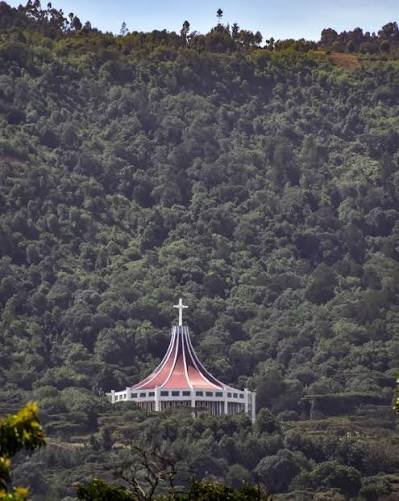
Subukia Shrine. This is the view from the Nakuru-Nyahururu highway. You can spot the shrine from quite a distance. The coordinates are Lat -0.0205050480999, Long 36.25313398. 📷 Ben Omwaka
It later became a significant feature of the shrine, with pilgrims incorporating the spring into their visits and religious practices.
The shrine’s history dates back to a call made by St. Pope John Paul II during his first apostolic visit to Kenya in May 1980.
During the visit, he challenged Kenyan Catholic bishops to establish a national spiritual sanctuary.
Four years later, Cardinal Maurice Michael Otunga officially opened and named the Subukia shrine.
Today, the site remains an important destination for Catholic pilgrims, with visitors travelling there for prayer and spiritual reflection.