

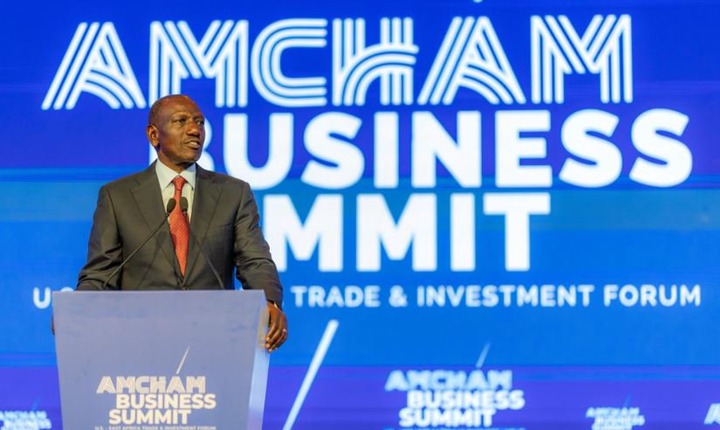
The United States has praised President William Ruto’s investment strategy as “bold” and progressive, with Assistant Secretary of State for African Affairs Frank Garcia declaring that Kenya is rapidly emerging as the primary commercial gateway to Africa’s expanding market.
Speaking at the 5th American Chamber of Commerce (AmCham) Kenya Business Summit in Nairobi, Garcia announced that Washington is executing a fundamental policy shift across the continent, transitioning away from traditional aid dependencies toward high-value trade, strategic investment, and commercial partnerships.
“Let me be direct: this is not a room for talk. This is a room built on deals,” Garcia told government leaders and corporate executives. He commended President Ruto’s administration for enacting key structural reforms to sharpen Kenya’s competitive edge, highlighting revised transfer pricing regulations, progress toward joining the Budapest Convention on Cybercrime, and the Strategic Goods Control Bill currently in Parliament.
Moving Beyond Aid: A New Paradigm for U.S.-Africa Relations
Garcia stressed that Africa sits at a “strategic inflection point” and possesses all the necessary elements – human talent, natural resources, and entrepreneurial energy – to serve as a global economic powerhouse.
Under the Trump administration, U.S. foreign policy toward sub-Saharan Africa prioritizes commercial deals over open-ended aid. Garcia noted that since the start of the administration, the U.S. State Department has closed 50 commercial transactions worth $28.2 billion across the region.
“For too long, U.S. policy toward Africa meant aid and dependency: open-ended commitments that asked nothing of anyone. Not anymore,” Garcia said. “Our partners want deals; they are tired of lectures and want opportunity, innovation, and cooperation.”
With Africa representing a $3.4 trillion market, Washington views Kenya as uniquely positioned to serve as a regional anchor as global supply chains seek greater resilience.
The Assistant Secretary also highlighted President Donald Trump’s signing of legislation on September 2 extending the African Growth and Opportunity Act (AGOA) by two years, securing continued duty-free access for over 70 percent of Kenya’s exports to the American market.
American Capital Expands Across Tech, Health, and Critical Minerals
A surge of major U.S. private sector deals demonstrates the momentum behind the bilateral relationship:
- Aviation & Travel Tech: Sabre and Kenya Airways finalized an $81 million agreement for a next-generation passenger service and ticketing platform.
- Entertainment & Infrastructure: U.S.-financed Zaria Group plans to construct a modern multi-purpose arena in Nairobi.
- Healthcare Expansion: Pfizer is introducing 15 new pharmaceutical products to bolster Kenya’s oncology treatment capabilities, while SC Johnson is building a malaria spatial emanator facility producing 20 million repellent units daily and supporting 200 local jobs.
- Digital Transformation & Infrastructure: Tech giants including Oracle, Microsoft, Cisco, Google, and Meta have launched programs to upskill more than 150,000 Kenyans. Simultaneously, Meta and Digital Realty unveiled an $80 million data center in Nairobi.
Addressing critical minerals, Garcia made it clear that Washington rejects traditional extractive models. Instead, the U.S. aims to back local refining, processing, and manufacturing, praising Kenya’s upcoming competitive bidding process for the Mrima Hill mineral deposits.
“American companies are not here to extract and ship. That is not partnership; that is extraction. We reject that model,” Garcia stated. “We want processing done right here on the ground in Kenya, not thousands of miles away.”
Expanded Commitments and Bilateral Initiatives
Adding to the summit’s announcements, U.S. Embassy Chargé d’Affaires Susan Burns unveiled several strategic initiatives:
- Fintech Innovations: Telcoin and PowerHive launched a blockchain-powered mobility financing platform designed in Kenya, enabling global investors to finance electric assets and settle payments via mobile wallets.
- Maritime & Customs Security: Enhanced joint efforts on container security, cargo screening, and border enforcement at the ports of Mombasa and Lamu.
- Agricultural Investment: The U.S. Department of Agriculture introduced a five-year, $19.2 million livestock innovation program to lower costs and boost feed quality.
- Startup Acceleration: The U.S. Embassy launched a SelectUSA Tech competition for Kenyan founders, offering the winning startup an opportunity to pitch directly to venture capital investors in the United States.
The fifth flagship AmCham Business Summit since 2018 brought together investors, policy experts, and business delegations from across East Africa and the United States, cementing Kenya’s position as a focal point for international trade and economic integration.