

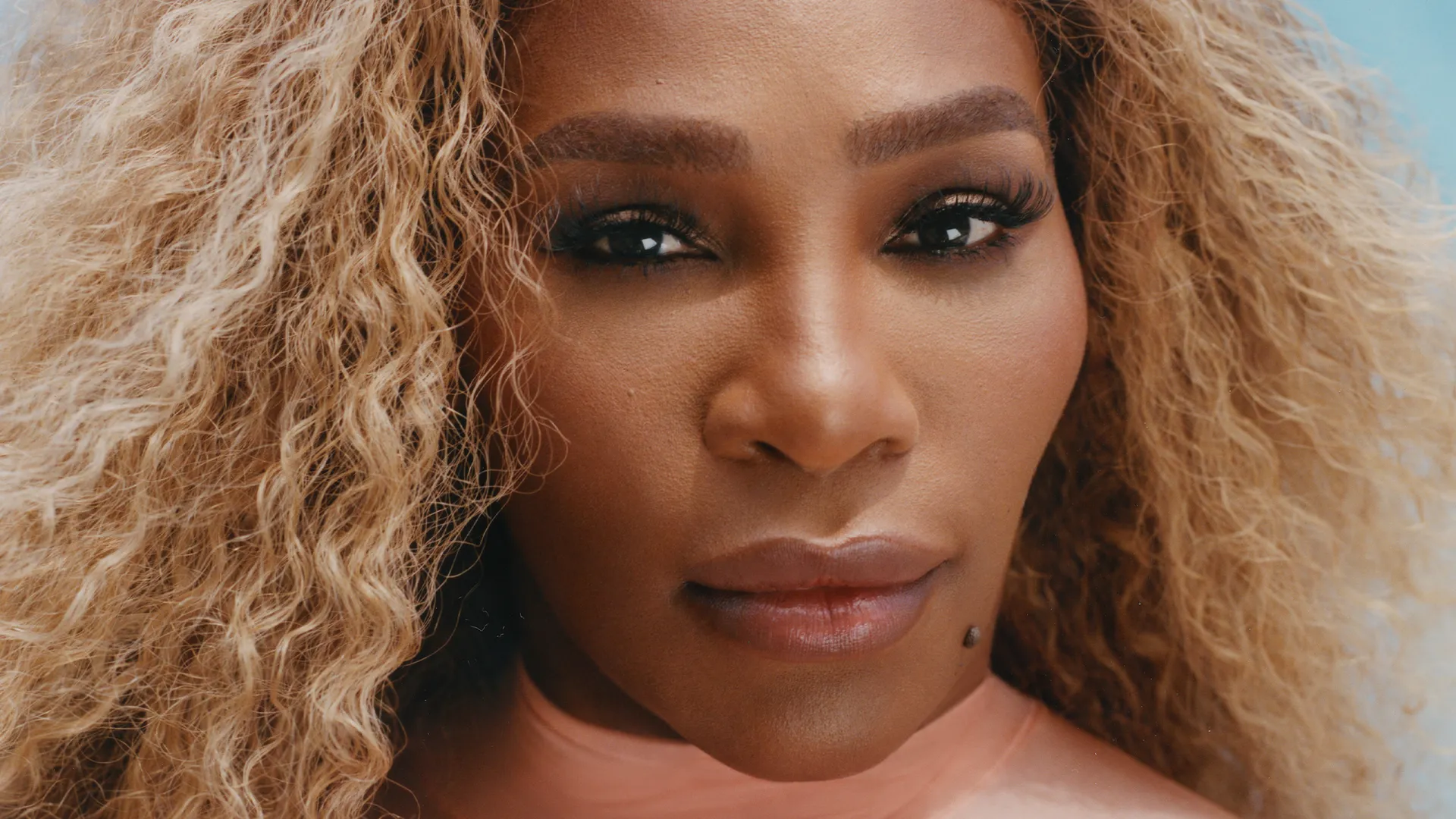
Every morning, Serena Williams wakes up and says to herself: “Put your best foot forward today.” It sounds obvious, coming from the literal Greatest of All Time—an athlete so decorated she constructed her own trophy room and whose 23 Grand Slam wins set a record for women in the Open Era. But for Williams, whom I meet at home in Jupiter, Florida, on the kind of blazing hot morning that bathes the ground in almost eerie white light, the new motto in fact represents personal growth.
To her it’s a concession. She can’t be perfect all the time. She can’t always summon the strength to conquer the morning. She can resolve only to give the day her best. “Sometimes my best foot is going to be really wobbly. It’s going to be really unstable,” she says, now settled onto a couch in her game room dressed in a fuchsia workout set and wrapped in one of her daughters’ blankets. “Every day is not going to be easy, but that’s the whole journey.”
It’s now been two years since Williams retired from professional tennis, wrapping up an operatic run at the very pinnacle of the game. In that time she netted not just those 23 Grand Slam titles, but four Olympic medals, a slew of doubles wins, and 319 weeks in the top spot of the Women’s Tennis Association rankings. She travelled the globe, the champion who represented the best of what athletics—and its attendant grit, determination, and sure, bravado—could be. With her parents, Richard Williams and Oracene Price, coaching both her and her older sister Venus, Williams shattered expectations—and boundaries—breaking into what was then (and can still be) a racist and sexist sport. It wasn’t her job to fix it, but fixing it is what Williams does. She sees a problem. She itches to solve it. But now she is done winning other people’s games. She is building toward a new kind of international domination.
Hence a post-retirement blueprint that revolves around not just her two daughters—Olympia, age seven, and Adira, one—whom she shares with her husband, Reddit cofounder Alexis Ohanian, but an ambitious venture fund that invests for the most part in founders who are women or people of colour (The problem: Just 2% of venture capital flows to women, and Black founders receive less than 0.5%), her makeup line WYN Beauty (The problem: Conventional makeup brands melted off her skin on the court or had paste-like formulations too thick to wear to dinner after a match), and a slew of partnerships and commitments that range from hosting the ESPYs on ESPN to serving as a parent volunteer at school (The problem: Williams can’t stand to be bored). This summer ESPN+ aired In the Arena: Serena Williams, an eight-part docuseries that serves as a career scrapbook, recalling in intimate and sometimes anguished detail the incredible highs and occasional lows of her tenure on the court.
Oh—also, she’s renovating her entire house. “I really realised I always need a project,” she says, stating the obvious while gesturing toward a board of carpet samples near our feet. Her tennis court is under construction too, which explains why Serena Williams has not so much as picked up a racket in three months. She’s “desperate” to play, but it becomes evident in the time we spend curled up on her couch that it’s not as if she has hours to spare for recreation.
Williams has timed this interview to overlap with Adira’s morning nap, having realised that it’s best to work around Adira’s sleep schedule. Olympia is in school, which means Williams must pack her personal and professional obligations into the hours between drop-off and pickup, which she likes to do herself. When she needs a break from pitch decks and investor calls, one of her favourite diversions is…doing the laundry, she tells me, smiling. “I love the smell of it,” she insists when I look skeptical. “I like things very, very neat.”
By GlamourMagazine