

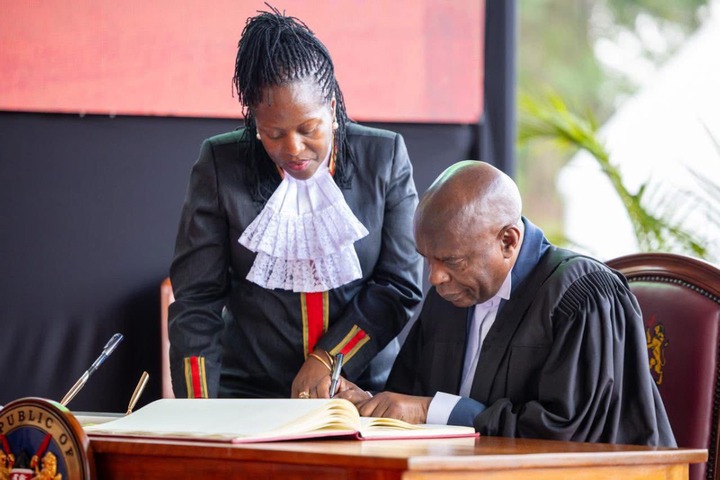
Renowned constitutional scholar and former Makueni Governor, Professor Kivutha Kibwana, has revealed what he describes as three critical issues he hoped to personally raise with President William Ruto during the recent Senior Counsel ceremony at State House.
While the occasion celebrated legal excellence and the elevation of advocates to the rank of Senior Counsel, Kibwana says time constraints denied him the opportunity to engage the President on matters he believes are central to Kenya’s political and economic stability.
Kibwana outlined what he called “mambo matatu”—three urgent concerns he felt warranted direct presidential attention. The first, he said, was the need for Kenya to avoid what he referred to as the “2025 Tanzanian way” in the lead-up to the 2027 General Election.
Though he did not elaborate in detail, the remark has been interpreted by observers as a warning against shrinking democratic space, intolerance of dissent, and heavy-handed state action during election periods.
Kibwana has long been an advocate for constitutionalism and the protection of civil liberties, and his statement reflects anxiety about democratic regression in the region.
The second issue relates to recurring youth unrest witnessed in 2023, 2024, and 2025. Kibwana argued that unresolved grievances among young people—driven by unemployment, rising living costs, and limited economic opportunities—pose a serious threat to national cohesion.
He stressed that protests and social tension should not be treated merely as law-and-order problems, but as symptoms of deeper structural challenges requiring policy-driven solutions.
Third, the former governor called for the revival of the Bottom-Up Economic Transformation Agenda, particularly for hustlers and the middle class.
While the policy was central to President Ruto’s campaign and early administration, Kibwana suggested its momentum has slowed, leaving many Kenyans feeling economically exposed.
He argued that without tangible relief for small traders, workers, and the struggling middle class, public confidence in economic reform will continue to erode.
Kivutha Kibwana noted that although he did not get the chance to directly convey these points to the President, he felt compelled to place them in the public domain.
By Creatorhub