

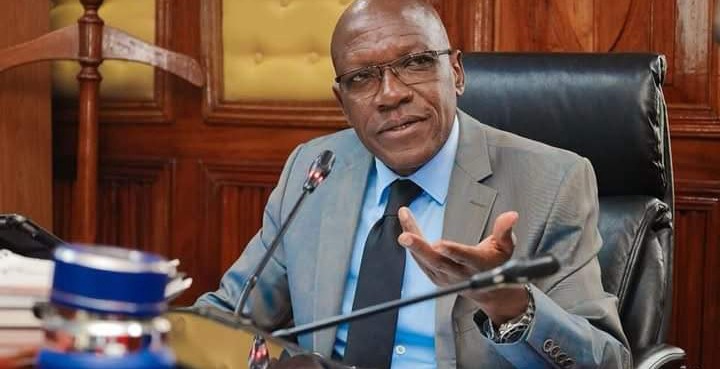
A dramatic moment unfolded in Trans Nzoia after police officers switched off Senator Boni Khalwale’s microphone as he began campaigning for Nairobi Senator Edwin Sifuna during the burial ceremony of the late Lazarus Opicho.
Khalwale, who was among political leaders attending the burial, had taken the microphone to address mourners when he shifted his remarks towards politics and began drumming up support for Sifuna.
His message, however, was abruptly interrupted after police officers reportedly ordered the microphone to be switched off.
The incident quickly attracted attention at the burial, with the interruption highlighting the growing sensitivity surrounding political mobilisation at public gatherings ahead of future electoral contests.
Khalwale is known for his outspoken political style and has frequently used public forums to advance political arguments and rally support for candidates and causes aligned with his political camp.
His attempt to campaign for Sifuna at the burial appeared to turn the solemn occasion into an unexpected political flashpoint.
Sifuna, the current Nairobi Senator, has increasingly emerged as a prominent political figure, particularly within opposition circles.
His political profile has continued to attract attention beyond Nairobi, with leaders and supporters seeking to position him for a wider national role.
The decision to cut Khalwale’s microphone underscored the delicate balance between political expression and the need to maintain order during funeral ceremonies.
Funerals in Kenya have traditionally served as important community gatherings where political leaders often address mourners, but such platforms have also increasingly become arenas for political mobilisation.
Witnesses at the ceremony watched as Khalwale’s address came to an abrupt halt, leaving his political message unfinished.
The incident is likely to fuel debate over whether political leaders should be allowed to campaign during funerals and other community ceremonies, particularly when their remarks involve active political contests.
For Khalwale, the interruption did little to diminish the attention surrounding his message.
Instead, the dramatic cutting of the microphone ensured that his brief appearance became one of the most talked-about moments of the burial.
As Kenya’s political landscape continues to heat up, scenes such as the one witnessed in Trans Nzoia illustrate how even solemn community occasions can quickly become stages for political rivalry, messaging and mobilisation.