

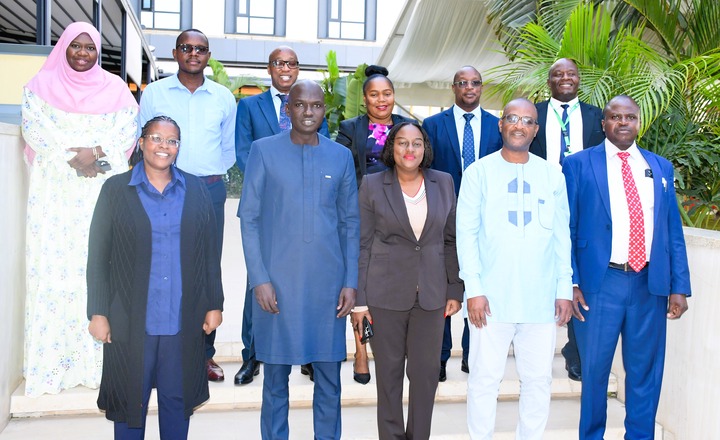
The National Biosafety Authority of Kenya and its counterpart in Senegal- National Biosafety Authority has agreed to work together in regulating GMOs in their respective countries.
Speaking in Nairobi during a meeting, with a delegation from Senegal, Kenya’s National Biosafety Authority (NBA) acting Chief Executive officer Dr. Ann Karimi underscored the importance of coming up with memorandum of agreements between various GMOs regulators in Africa to ease work in relating GMOs.
“These memorandum of agreements are crucial for our work especially under risks assessment which will be case by case. This will be guided data transportability policy that has already been developed by Kenya,” said Dr. Karimi.
She appreciated the visit by the delegation to share Kenya’s experience in the establishment and implementation of a functional national biosafety regulatory system.
“Your visit comes at an important time when African countries are increasingly recognizing the role of modern biotechnology in addressing food security, climate change, crop diseases, pests, environmental protection and sustainable agricultural transformation. At the same time, our countries have a shared responsibility to ensure that biotechnology is developed, transferred, handled and used safely, responsibly and in accordance with national laws and international obligations,” said Dr Karimi.
She observed that Kenya and Senegal share many common development aspirations.
“Both countries are committed to strengthening agricultural productivity, protecting biodiversity, supporting innovation and building public confidence in science-based decision-making. This engagement therefore provides an excellent opportunity for peer learning, exchange of experiences and the strengthening of cooperation between our institutions,” added Dr. Karimi.
The Authority was established under the Biosafety Act, 2009, with the mandate to exercise general supervision and control over the transfer, handling and use of genetically modified organisms in Kenya.
“Over the years, Kenya has developed a national biosafety framework that includes laws, regulations, institutional structures, technical review processes, risk assessment mechanisms, monitoring and compliance systems, public awareness programmes and stakeholder engagement platforms,” said Dr. Karimi.
She added that the Authority is happy to share with Senegal, Kenya’s journey, including the progress made, lessons learnt and challenges encountered in implementing biosafety governance.
“Our experience shows that an effective biosafety system requires strong legislation, technical capacity, institutional coordination, transparency, public participation, credible communication and sustained political and financial support,” said the acting Chief Executive Officer.
She said the benchmarking visit will not only benefit Senegal and Kenya but will also contribute to strengthening biosafety systems across the African continent.
“As institutions mandated with biosafety oversight, there is great value in collaboration between the National Biosafety Authority of Kenya and the relevant biosafety institutions in Senegal. Possible areas of collaboration include technical exchange, capacity building, information sharing, joint training, regulatory cooperation, public awareness approaches, participation in regional and international biosafety processes, and sharing of experiences in implementing the Cartagena Protocol on Biosafety,” said Dr. Karimi.
Senegal’s Biosafety National Authority General Director Prof. Aliou Ndiaye, who was accompanied by Dr Colonel Lamine Kane, General Secretary and Ms. Aïssatou Ndiaye, Executive Secretary observed that the rapid evolution of modern and emerging biotechnologies and their applications, are now well established and have become a global reality.
“Consequently, the African states must integrate this global reality, in order to take advantages of the ongoing biotechnological transformation in the fields of agriculture, health, and environment,” said Prof Ndiaye.
He emphasized the continuous capacity building within the two institutions saying its essential in order to derive maximum benefit from these modern and emerging biotechnologies and their applications.
As part of the visit, the Senegalese delegation will tour key facilities involved in GMO testing and biosafety oversight at the Kenya Agricultural and Livestock Research Organization (KALRO). At KALRO-Muguga, the team will learn about genetically modified potato varieties that are being tested to improve yields and enhance resistance to diseases. The delegation will also visit KALRO-Kandara, where research on genetically modified cassava is underway.
The benchmarking visit aims to share Kenya’s experience in biosafety legal, policy, and institutional frameworks; exchange knowledge on GMO application review, risk assessment, decision-making, inspection, and post-approval monitoring; demonstrate the role of GMO testing laboratories in biosafety regulation and trade facilitation; showcase confined field trial management practices; and identify priority areas for collaboration, capacity building, and possible formal cooperation between the two biosafety authorities.
On Thursday, the delegation will pay a courtesy call on the Agriculture Principal Secretary, Dr. Paul Ronoh.
The Authority is the National Focal for the implementation of the Cartagena Protocol on Biosafety. Kenya signed the Cartegena Protocol on Biosafety in 2000 and ratified it in 2003.