

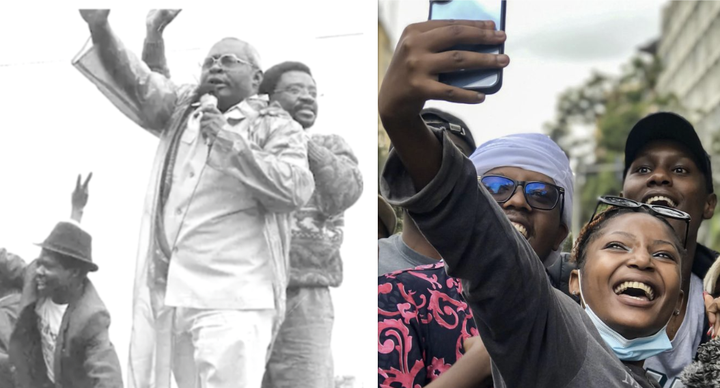
Kenya will mark yet another Saba Saba Day on July 7, where the country remembers the past and the achievements gained through civil and political activism.
However, in recent times, activism, protest culture and civic resistance have evolved in the digital age. What began as a defiant rally at Kamukunji Grounds in 1990 has morphed into a movement that now thrives on smartphones, hashtags, and livestreams.
Saba Saba — referencing the 7th day of the 7th month — holds a revered place in Kenya’s history as a symbol of resistance, democracy, and public defiance.
The day came to be on July 7, 1990, when a group of opposition leaders — among them Kenneth Matiba, Charles Rubia, and Jaramogi Oginga Odinga — called for a rally at Nairobi’s Kamukunji Grounds to demand the introduction of multiparty democracy under President Daniel arap Moi’s oppressive one-party rule.
The regime, notorious for detentions without trial, censorship, and political intimidation, swiftly banned the meeting, but the people defied the ban.
Thousands turned up, and the state responded leading to the detention of many, and lives were lost, but a critical message had been delivered.
The events of that day culminated in the repeal of Section 2A of the Constitution in 1991, reintroducing multiparty democracy to Kenya for the first time after years.
And three and a half decades later, the day still holds significance in the country’s democracy and activism, although mobilisation has now moved to TikTok lives and Twitter threads.
While the 1990 protests focused squarely on political pluralism, subsequent Saba Saba commemorations have addressed a widening list of grievances.
In the 2000s, protestors demanded constitutional reforms and human rights protections. Figures like Wangari Maathai linked Saba Saba to environmental justice, while Paul Muite campaigned for a people-driven constitution.
Another shift was witnessed under a different generation in the 2010s, which saw themes of police accountability, extrajudicial killings, and economic fairness take center stage.
By the 2020s, the Gen Z and millennials picked up the mantle. Their demands included digital rights, tax justice, job creation, and public service reforms.
Over the decades, there has been a generational relay of defiance, with each era expanding the protest’s scope while preserving its mission of holding power to account.
Unlike the Kamukunji generation, today’s Saba Saba activists rally on TikTok, X (formerly Twitter), Facebook, and Telegram.
Hashtags like #SabaSabaMarchForOurLives, #RejectFinanceBill, and #EndPoliceBrutalityKE have turned digital spaces into powerful arenas for civic action.
During the Gen Z-led anti-Finance Bill protests of 2024, over 500,000 social media posts bearing protest hashtags were recorded within 48 hours, according to a report by AfricTivist Watch.
Protest routes, police alerts, and live coverage moved rapidly via Telegram groups and TikTok livestreams. One of the digital activists, Boniface Mwangi, once said, “Social media has become our Kamukunji. It’s where we plan, express, and demand accountability.”
Despite its occasional waning visibility, Saba Saba’s has created an impact in the country by ensuring better governance and accountability.
Some of the achievements witnessed over the years include;
-Multiparty Democracy: the 1990 protests forced the repeal of Section 2A in 1991, ending one-party rule.
-Civil Society Empowerment: The movement emboldened NGOs and citizen groups to challenge state excesses, establishing a thriving civic sector.
-Constitutional Reforms: Saba Saba pressure was instrumental in the drafting of Kenya’s transformative 2010 Constitution.
-Youth Involvement in Governance: The 2020s have seen a surge in youth engagement, interest in electoral contests, participation in the budget-making process, among others.
-Digital Freedoms and Youth Empowerment: Online platforms now provide safe spaces for organising and amplifying dissent.
-Police Accountability: Campaigns against extrajudicial killings and police brutality have become central to recent protests, with notable mobilisations in 2020 and 2024 leading to ongoing and future police reforms.
By Kenyans