

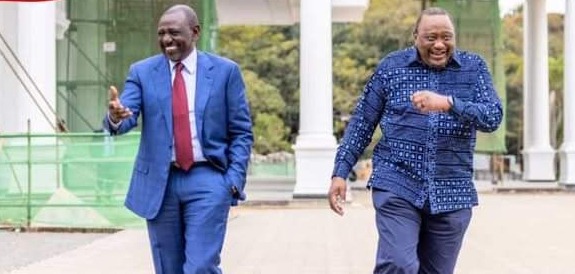
President William Ruto has disclosed details of a private conversation he held with former president Uhuru Kenyatta, revealing that their discussions focused on long-term strategies to transform Kenya’s economy and improve the lives of future generations.
Speaking during a roundtable interview with journalists in Wajir County, Ruto said he reached out to leaders from across the political divide following the 2022 General Election to seek ideas and support for a shared national development agenda.
The president explained that his consultations were not limited to one individual, noting that he engaged many leaders from different regions and backgrounds.
However, he acknowledged that he personally sat down with Uhuru to discuss what Kenya should look like over the next 15 to 20 years.
“That’s a difficult question because I do not want to offend people. I reached out to as many people as I could and worked with many people across Kenya,” Ruto said.
According to the head of state, the discussions centered on sectors that are critical to Kenya’s economic growth.
He identified energy generation, infrastructure development and agricultural expansion as key areas requiring significant investment.
Ruto noted that Kenya needs more power production to support industrialisation and job creation.
He also called for increased investment in roads, highways, airports, seaports and transport networks to improve connectivity and boost trade.
On food security, the president said Kenya remains food-deficient and must expand irrigation projects to increase agricultural output.
He reiterated his administration’s plan to place an additional 2.5 million acres under cultivation to enhance food production and strengthen exports.
The president expressed optimism that large-scale irrigation initiatives, particularly in northern Kenya, could unlock vast agricultural potential and contribute significantly to national growth.
Ruto further urged leaders to focus on decisions that benefit future generations rather than concentrating solely on electoral politics, arguing that successful nations are built through long-term planning and visionary leadership.