

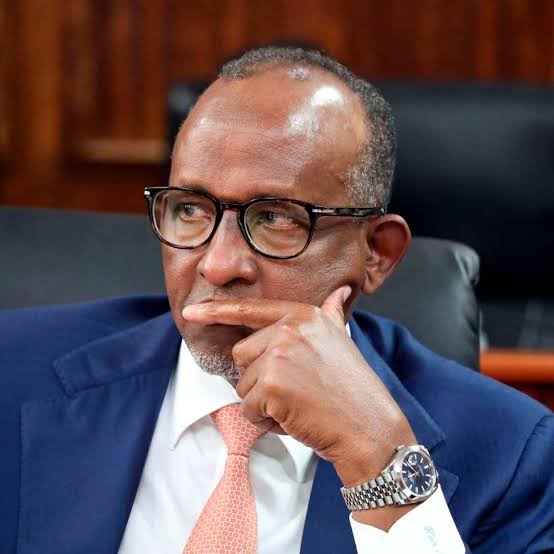
Health Cabinet Secretary Aden Duale has dismissed reports claiming that a man in Wajir County was suspected of having Ebola, urging the public not to rely on unverified information circulating online.
Duale rejected the reports when contacted for comment, stating that the claims were not true.
The reports had alleged that health officials in Wajir were monitoring a man who had reportedly travelled from the Democratic Republic of Congo (DRC) and later developed a severe illness.
According to the claims, the man had sought medical attention in several locations before reaching Wajir, where his condition was said to have deteriorated despite treatment.
The reports further alleged that he had experienced symptoms such as fever, headache and coughing. They also claimed that he was suffering from severe anaemia, with his haemoglobin level reportedly standing at 4g/dL.
There were also claims that the man had travelled by trailer through several countries, spending several days in different locations while seeking medical assistance.
The reports said he eventually reached Malaba before travelling through Nairobi and Isiolo and later returning to his home area in Wajir.
He was reportedly treated for conditions including pneumonia and septicaemia for several days without showing significant improvement.
However, there has been no confirmation that the man had Ebola. The reports were rejected by Duale, who said the information being circulated was not true.
The clarification comes as Kenya continues strengthening its surveillance and preparedness measures following the confirmation of an imported Ebola Virus Disease case.
The government previously confirmed that the patient died while receiving treatment in Nairobi. Authorities said the deceased was safely buried in line with established public health protocols.
The government has maintained that surveillance and rapid-response teams are operating across the country to detect and manage any possible cases.
As of October 6, authorities said Kenya had screened 652,584 travellers and tested 267 samples through five laboratories.
Of the samples tested, one had returned positive. That result belonged to the deceased patient, with authorities reporting that no additional positive cases had been detected as of Tuesday.
The government has also increased the number of health workers trained to respond to Ebola and other serious infectious diseases.
A total of 4,971 healthcare workers have reportedly received training at national and sub-national levels in Ebola prevention, detection and management.
Several health facilities have been designated to handle suspected or confirmed Ebola cases if the need arises.
These include Kenyatta National Hospital, which has eight designated beds, Moi Teaching and Referral Hospital with 50 beds, National Police Hospital with 49 beds and The Nairobi Hospital with 143 beds.
Authorities said the available capacity could be increased by designating additional facilities depending on how the public health situation develops.
The government has also urged Kenyans to remain calm while continuing to follow health precautions.
Members of the public have been encouraged to maintain proper hand hygiene and avoid unnecessary contact with people showing symptoms that could be associated with Ebola or other serious infectious diseases.
Symptoms associated with Ebola can include fever, severe headache, muscle pain, weakness, vomiting, diarrhoea and unexplained bleeding.
The clarification on the Wajir reports is therefore significant because unverified claims about infectious diseases can cause unnecessary fear, particularly when the country is already operating heightened surveillance measures.
For now, the government has not confirmed a second Ebola case linked to the alleged Wajir patient.
Health authorities continue to rely on laboratory testing and official surveillance systems to establish whether suspected cases are genuine rather than relying on information circulating on social media.
Kenyans have consequently been urged to seek information from the Ministry of Health and other authorised government channels whenever reports of suspected infectious disease cases emerge.