

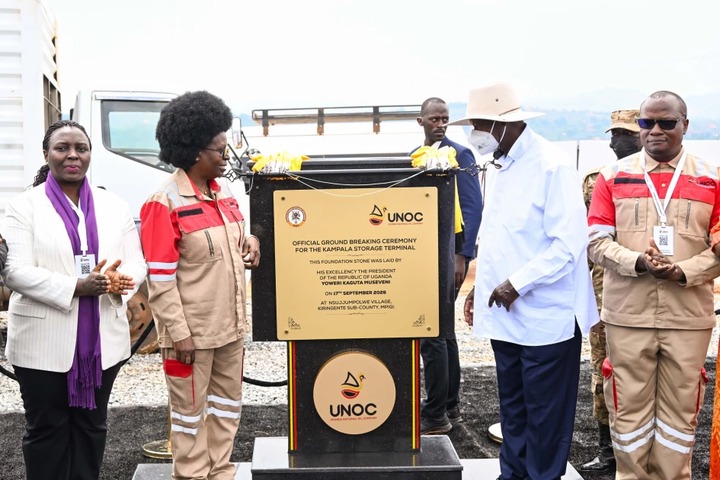
Ugandan President Yoweri Museveni has revealed that a Kenyan senator first alerted him to the fact that Uganda was purchasing petroleum products through middlemen based in Kenya, a discovery that prompted decisive government intervention and a major overhaul of the country’s fuel import system.
Speaking on Thursday, 17 September 2026, while breaking ground for the 320-million-litre Kampala Storage Terminal in Mpigi District, Museveni expressed disbelief that such an arrangement had persisted under the watch of senior technocrats in the Ministry of Energy. “When we took over government in 1986, we tried to hand over the administration of government to the learned technocrats in the ministries. Now, in the Ministry of Energy, with Permanent Secretaries and Commissioners, it took a Senator in Kenya to bring a serious matter to my attention that Uganda was buying petroleum products through middlemen in Kenya. Unbelievable,” he said.
Museveni recounted that the unnamed Kenyan senator approached him and pointed out that Uganda was sourcing fuel through intermediaries rather than dealing directly with refiners and bulk suppliers. He said he immediately contacted the then Minister of Energy and Mineral Development, Irene Muloni, describing the situation as “a disaster.” According to the President, the matter was not acted upon at the time.
The revelation eventually led Museveni to push for reforms that placed the Uganda National Oil Company (UNOC) at the centre of petroleum procurement. Uganda shifted to direct contracts with bulk suppliers, notably the global trader Vitol. Officials present at the ceremony confirmed the financial impact of the change. Diesel premiums dropped from US$118 to US$83 per metric tonne, petrol from US$97.50 to US$61.50, and aviation fuel from US$114.25 to US$79.25.
Museveni criticised the previous system, which had been presented in some cases as a government-to-government arrangement but in practice involved traders who inflated costs. He argued that a country importing approximately 2.5 billion litres of petroleum products annually, valued at around US$2 billion, should never have relied on middlemen when direct access to refiners was available.
The new Kampala Storage Terminal, financed in part through an agreement with Vitol Bahrain, is expected to enhance Uganda’s strategic fuel reserves and reduce vulnerability to supply disruptions. Officials said the facility will initially hold 225 million litres, expanding to the full 320 million litres in a later phase.
By ending reliance on Kenyan-based intermediaries and securing lower premiums, Uganda has sought to lower the cost of fuel for consumers and oil marketing companies. Museveni’s account underscores both the role of external whistleblowing and the long-standing challenges of ensuring accountability in critical national supply chains. The President did not name the Kenyan senator who first raised the issue.