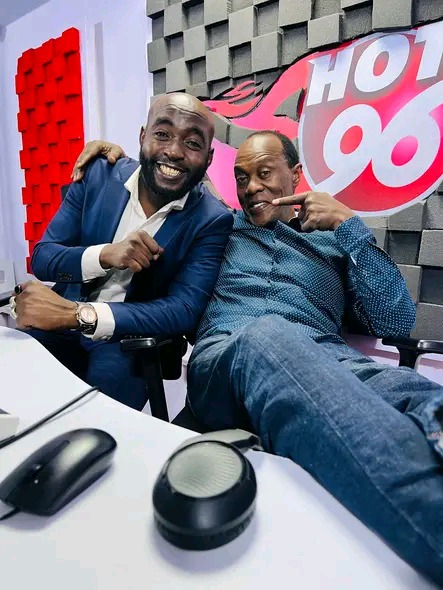
Today morning, it was really a joyous and fun atmosphere at Hot 96 among the radio and TV personalities led by Captain Jeff Koinange making a famous comeback from Citizen TV.

His first officer, Brand Patrick Igunza was also with him in the studio. The two of them were full of life, laughter, and an easygoing manner that they used to communicate with the audience of the long weekend on this Monday morning.

In no time, they made a great rapport with the listeners during the holiday long weekend.

Jeff Koinange, a media personality known far and wide in Kenyan media, to which you could always look for brave and bold reporting resulting in an engaging broadcast experience, is quite the talk of his triumphant return to the airwaves.

His fans could not be more happy; they were the first to tune in to hear him and Igunza launch into talks, current events, and teasing each other in an upbeat manner.

Actually, their teamwork was very obvious thus co-presentations were both entertaining and educational for all ages of listeners.

It was step one of the radio show that tasked listeners with reporting on their weekend plans thereby creating the feeling of belonging among audience members.

Discussions were Jamhuri Day celebrations from holiday getaways and family get-togethers to deep thoughts.

People in various areas were calling with their experiences, humorous sayings, and holiday wishes thus expanding the inflow of interaction.

The return of Jeff and Igunza on air was not solely to bring in money through entertainment but also an embodiment of Kenyan culture and national unity.

Their style was attractive and easy for all to grasp hence audiences were reminded of radio’s continued power especially in festive moments.

The two newsmen cleverly blended news, jokes from their lives, and the audience’s participation to keep the spirit going throughout the morning.

So far, Jeff Koinange’s new show at Hot 96 comes with a sigh of relief for Kenyans expressing just what a great moment it has been long awaited.

We have reasons to believe this radio program will be vibrant and innovative in the media scene with Jeff Koinange as the driver and Hot 96 the venue, providing us a very good mixture of facts, laughter, and togetherness to be enjoyed by anyone on Jamhuri Day.

By Kenyans

By admin

Leave a Reply

Your email address will not be published. Required fields are marked *

You missed

The United States military has conducted precision missile strikes against Islamic State (ISIS) targets in northwest Nigeria, signaling a new phase of active U.S. military engagement in West Africa. The operation, ordered by U.S. President Donald Trump on Christmas Day, involved warships firing long-range missiles from the Gulf of Guinea into Sokoto State, where ISIS-affiliated militants have increased activities in recent months. Video footage released by the U.S. Department of War shows missiles being launched from a U.S. Navy surface combatant operating at sea. Defense analysts assess that the strike likely involved Tomahawk cruise missiles fired from an Arleigh Burke-class guided-missile destroyer — a platform routinely used by the U.S. Navy for long-range precision strikes. The missiles reportedly struck at least two ISIS camps, killing multiple militants, according to a statement from the U.S. military’s Africa Command (AFRICOM). The action marks one of the first publicly acknowledged uses of sea-launched cruise missiles against targets on Nigerian soil. Following the strikes, U.S. Defense Secretary Pete Hegseth thanked the Nigerian government for its support and cooperation, adding cryptically on social media that there is “more to come…” — suggesting additional operations could follow. Nigerian officials also affirmed the strikes were conducted as part of ongoing security cooperation with the United States, emphasizing intelligence sharing and strategic coordination to target extremist groups. A Nigerian foreign ministry post described the impact as “precision hits on terrorist targets” in the northwest. The operation comes amid increased activity by Islamic State-linked groups in Nigeria — particularly the Islamic State Sahel Province (ISSP), sometimes known locally as Lakurawa. This faction has been active in northwestern states such as Sokoto and Kebbi, involved in kidnappings, killings, and attacks on security forces. The U.S. and Nigerian governments have reported conducting intelligence flights over Nigeria since late November, underscoring weeks of planning before the strike. Reuters confirmed U.S. military aircraft and surveillance efforts have been visible across the region as part of preparatory operations. U.S. authorities have framed the strikes as retaliation against militants responsible for violent attacks, including claims that extremist groups are targeting Christian communities. President Trump described the action as a powerful military response to “terrorist scum” committing atrocities, particularly against Christians — a characterization that has sparked international debate about the motivations behind the intervention. Nigerian government officials have stressed that extremist violence affects communities across religious lines and that cooperation with the U.S. aims to address broader security challenges rather than a single sectarian narrative. With President Trump’s warning of further military actions and continued joint efforts between U.S. and Nigerian forces, this strike may herald a broader counter-terrorism campaign in the region. Analysts say long-term stability will require more than kinetic operations, pointing to issues like governance, local security capacity, and socioeconomic development.