

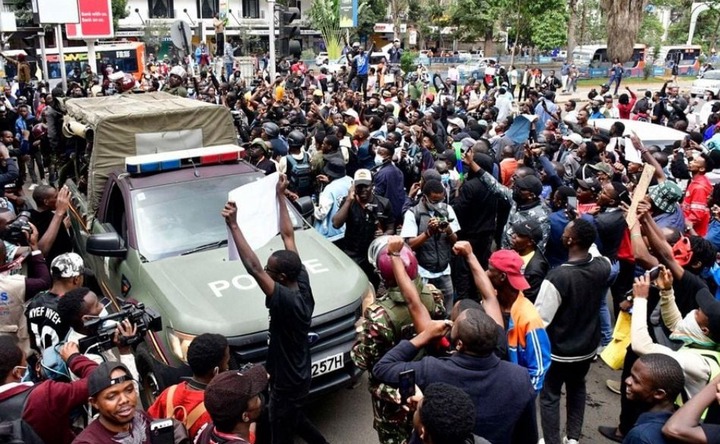
Ngong town turned into a hotspot of resistance on Monday as protesters poured into the streets, chanting against the current regime. The demonstrations were part of the broader Saba Saba movement, which gained new life this year under the leadership of determined youth, many of them from Generation Z.
Despite a strong deployment of security officers, crowds moved steadily through key sections of the town. Makeshift barricades by police failed to stop the protesters, who were vocal in their discontent over the rising cost of living, alleged mismanagement, and what they termed as a disconnect between the leadership and the public.
What began as a commemorative day rooted in Kenya’s struggle for multiparty democracy has evolved into a new wave of civil resistance. From Ngong to Kiserian, and even parts of Nairobi and Mwea, pockets of unrest were reported. Tear gas filled the air in several neighborhoods as clashes broke out between demonstrators and law enforcement.
The government’s response was swift and firm. Access to central Nairobi was heavily restricted, paralysing transportation and causing delays for thousands of commuters. Security agencies cited intelligence concerns, and the suspension of rail services further signaled the administration’s apprehension about the scale of the unrest.
In Kamukunji, crowds gathered in anticipation of a political address that many hoped would lend direction to the spontaneous protests erupting nationwide. Though the protests were leaderless in some areas, the symbolism of Saba Saba has clearly resonated with young people who feel sidelined by traditional politics.
By Newshub