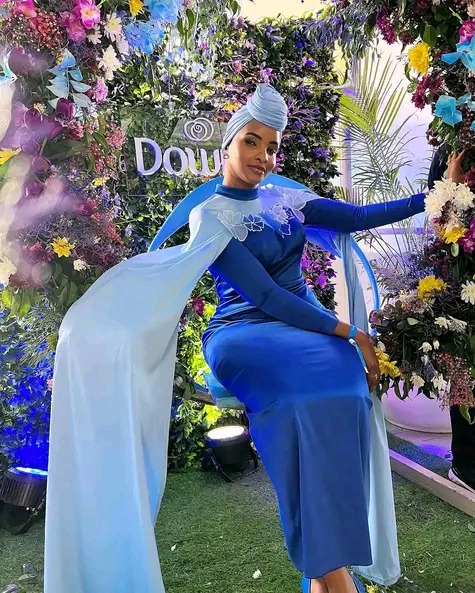
Lulu Hassan, who’s a top journalist in Kenya, gave Jeff Koinange a big welcome back to the media world.

Lulu, who’s known for being super professional and on-point at Citizen TV, seemed really excited to see Jeff back.

Her message showed just how much respect everyone has for him.

People watching and working in the media are pretty happy about Jeff’s return. He’s a well known name, and has made his career by being courageous in his reporting, and being good at talking to people of all ages.

A lot of people see his return as a good thing for Kenyan news, you know at a time when folks really value real and believable stories.

Lulu’s welcome kinda made it clear how much of an impact Jeff has had on the media scene. She described him as someone who changed the rules and an inspiration to younger reporters.

She talked about how good he is at handling stories with care, understanding, and always telling the truth – that’s what he’s collected a lot of awards over the years.

Her welcome showed the good feeling and respect that Kenyan journalists have for each other, and how they all want to give the public correct news.

This get-together also got people talking about how Kenyan journalism has changed. Many people think Jeff coming back will bring some fresh energy and know-how to the business.

People think he’ll set a good example for how to present news, poke around for the truth, and tell stories, which will rub off on other reporters.

Lulu Hassan’s public shout-out, which was simple but real, showed the human side of journalism. It reminded people that behind the news, there are relationships, teaching, and respect.

Her welcoming Jeff Koinange was more than just a hello; it was a celebration of skill, professionalism, and the lasting effect of a journalist who’s shaped how Kenyans get their news.

By Newshub

By admin

Leave a Reply

Your email address will not be published. Required fields are marked *

You missed

The United States military has conducted precision missile strikes against Islamic State (ISIS) targets in northwest Nigeria, signaling a new phase of active U.S. military engagement in West Africa. The operation, ordered by U.S. President Donald Trump on Christmas Day, involved warships firing long-range missiles from the Gulf of Guinea into Sokoto State, where ISIS-affiliated militants have increased activities in recent months. Video footage released by the U.S. Department of War shows missiles being launched from a U.S. Navy surface combatant operating at sea. Defense analysts assess that the strike likely involved Tomahawk cruise missiles fired from an Arleigh Burke-class guided-missile destroyer — a platform routinely used by the U.S. Navy for long-range precision strikes. The missiles reportedly struck at least two ISIS camps, killing multiple militants, according to a statement from the U.S. military’s Africa Command (AFRICOM). The action marks one of the first publicly acknowledged uses of sea-launched cruise missiles against targets on Nigerian soil. Following the strikes, U.S. Defense Secretary Pete Hegseth thanked the Nigerian government for its support and cooperation, adding cryptically on social media that there is “more to come…” — suggesting additional operations could follow. Nigerian officials also affirmed the strikes were conducted as part of ongoing security cooperation with the United States, emphasizing intelligence sharing and strategic coordination to target extremist groups. A Nigerian foreign ministry post described the impact as “precision hits on terrorist targets” in the northwest. The operation comes amid increased activity by Islamic State-linked groups in Nigeria — particularly the Islamic State Sahel Province (ISSP), sometimes known locally as Lakurawa. This faction has been active in northwestern states such as Sokoto and Kebbi, involved in kidnappings, killings, and attacks on security forces. The U.S. and Nigerian governments have reported conducting intelligence flights over Nigeria since late November, underscoring weeks of planning before the strike. Reuters confirmed U.S. military aircraft and surveillance efforts have been visible across the region as part of preparatory operations. U.S. authorities have framed the strikes as retaliation against militants responsible for violent attacks, including claims that extremist groups are targeting Christian communities. President Trump described the action as a powerful military response to “terrorist scum” committing atrocities, particularly against Christians — a characterization that has sparked international debate about the motivations behind the intervention. Nigerian government officials have stressed that extremist violence affects communities across religious lines and that cooperation with the U.S. aims to address broader security challenges rather than a single sectarian narrative. With President Trump’s warning of further military actions and continued joint efforts between U.S. and Nigerian forces, this strike may herald a broader counter-terrorism campaign in the region. Analysts say long-term stability will require more than kinetic operations, pointing to issues like governance, local security capacity, and socioeconomic development.