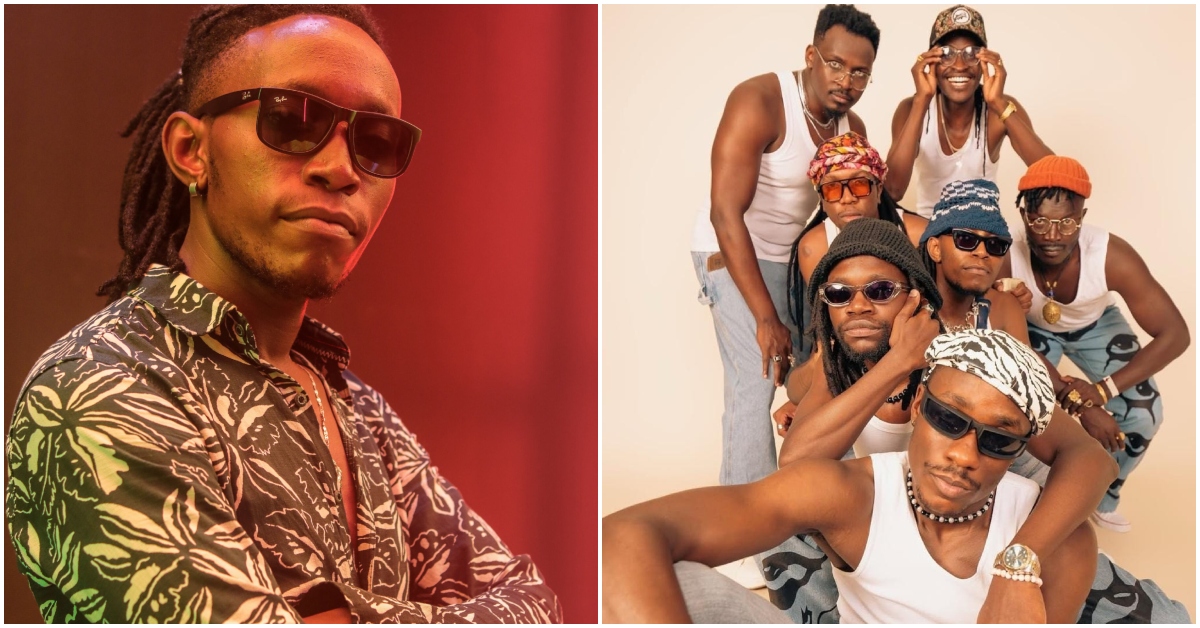
What was meant to be a historic night at Nyayo Stadium turned into a painful stand for dignity. Singer Bensoul has finally opened up about the moments that led Kodong Klan to withdraw from the highly anticipated Asake and Gabzy concert, revealing a story marked by disrespect, frustration, and a hard line drawn in the sand.

Kodong Klan — a powerful collective featuring Bensoul, Charisma, Okello Max, Mordecai Dex (Hart the Band), Coster Ojwang, Ywaya Tajiri, and Israel Onyach (Watendawili) — had been booked to share the stage with global stars. Instead, they found themselves fighting to be heard even before the music began.

Speaking in an interview on Thursday, December 25, 2025, Bensoul recalled how plans abruptly changed during rehearsals. While some members were already on stage for their scheduled soundcheck at Nyayo, word came down — suddenly and publicly — that everything had shifted.

“We were already on stage, instruments set, ready to work,” Bensoul said. “Then someone announced on the mic, ‘Change of plans. Asake will do soundcheck first.’ That alone was disrespectful.”

The announcement wasn’t whispered backstage. It was broadcast over the microphone — a move that humiliated the group in front of crews and peers alike.

“Ati shukeni chini, mnaambiwa kwa mic… that was pure disrespect,” he said.

Beyond pride, the interruption had real consequences. Their instruments and lighting had already been calibrated. Pulling them off stage mid-process meant their rehearsal was compromised, their performance integrity shaken.

Despite arriving on time and following every protocol, Kodong Klan felt their effort and professionalism were repeatedly dismissed.

That was the breaking point. “If we performed under those conditions, we’d be saying this kind of treatment is okay,” Bensoul explained. “It’s not. Respect is non-negotiable.”

After consulting with management, the group made the painful but firm decision to withdraw — not out of ego, but principle.

Known for songs like Nyaduse and Disko, Kodong Klan emphasized that walking away was about protecting standards, self-worth, and the future of Kenyan artists demanding respect on major stages.

Sometimes, the loudest statement isn’t made with a microphone — but by choosing to walk away.

By TV47

By admin

Leave a Reply

Your email address will not be published. Required fields are marked *

You missed

The United States military has conducted precision missile strikes against Islamic State (ISIS) targets in northwest Nigeria, signaling a new phase of active U.S. military engagement in West Africa. The operation, ordered by U.S. President Donald Trump on Christmas Day, involved warships firing long-range missiles from the Gulf of Guinea into Sokoto State, where ISIS-affiliated militants have increased activities in recent months. Video footage released by the U.S. Department of War shows missiles being launched from a U.S. Navy surface combatant operating at sea. Defense analysts assess that the strike likely involved Tomahawk cruise missiles fired from an Arleigh Burke-class guided-missile destroyer — a platform routinely used by the U.S. Navy for long-range precision strikes. The missiles reportedly struck at least two ISIS camps, killing multiple militants, according to a statement from the U.S. military’s Africa Command (AFRICOM). The action marks one of the first publicly acknowledged uses of sea-launched cruise missiles against targets on Nigerian soil. Following the strikes, U.S. Defense Secretary Pete Hegseth thanked the Nigerian government for its support and cooperation, adding cryptically on social media that there is “more to come…” — suggesting additional operations could follow. Nigerian officials also affirmed the strikes were conducted as part of ongoing security cooperation with the United States, emphasizing intelligence sharing and strategic coordination to target extremist groups. A Nigerian foreign ministry post described the impact as “precision hits on terrorist targets” in the northwest. The operation comes amid increased activity by Islamic State-linked groups in Nigeria — particularly the Islamic State Sahel Province (ISSP), sometimes known locally as Lakurawa. This faction has been active in northwestern states such as Sokoto and Kebbi, involved in kidnappings, killings, and attacks on security forces. The U.S. and Nigerian governments have reported conducting intelligence flights over Nigeria since late November, underscoring weeks of planning before the strike. Reuters confirmed U.S. military aircraft and surveillance efforts have been visible across the region as part of preparatory operations. U.S. authorities have framed the strikes as retaliation against militants responsible for violent attacks, including claims that extremist groups are targeting Christian communities. President Trump described the action as a powerful military response to “terrorist scum” committing atrocities, particularly against Christians — a characterization that has sparked international debate about the motivations behind the intervention. Nigerian government officials have stressed that extremist violence affects communities across religious lines and that cooperation with the U.S. aims to address broader security challenges rather than a single sectarian narrative. With President Trump’s warning of further military actions and continued joint efforts between U.S. and Nigerian forces, this strike may herald a broader counter-terrorism campaign in the region. Analysts say long-term stability will require more than kinetic operations, pointing to issues like governance, local security capacity, and socioeconomic development.