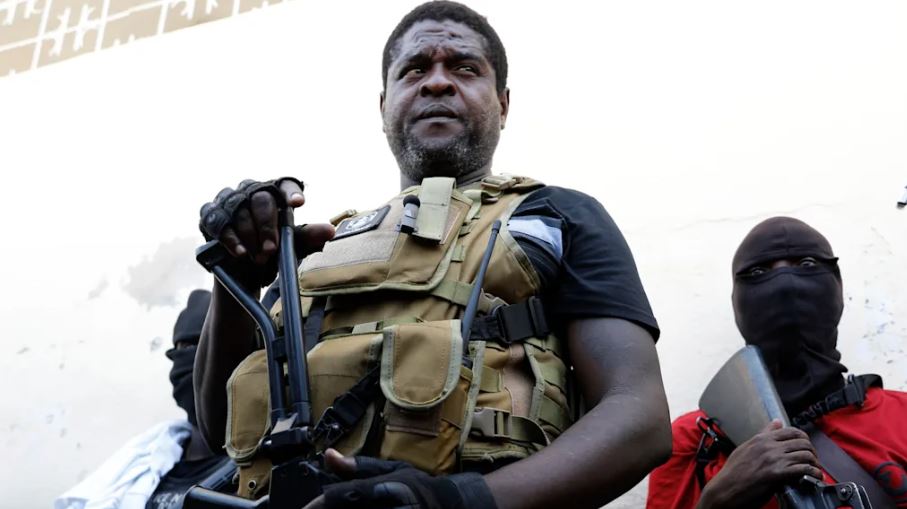
Jimmy Chérizier, nicknamed Barbecue, is a Haitian gang leader.
At least three Haitian soldiers were killed in a gang ambush Sunday in a town on the outskirts of Haiti’s capital of Port-au-Prince, Haitian authorities confirmed.

Kenya police, who are operating under the Multinational Security Support Mission (MSS), joined to fight off the gang’s advances.

The area of Kenscoff has been under heavy fire in recent days as Haitian law enforcement has warred with the gang coalition known as Viv Ansanm.

It’s just the latest explosion of violence as Haitian authorities and foreign forces scramble to rein in gang warfare in the Caribbean nation.

Haiti’s government in a post on the social media platform X wrote that the soldiers died “on the front line … weapons in hand.”

“These soldiers are not just members of our armed forces. They are worthy sons of the Nation, defenders of our sovereignty, whose ultimate sacrifice will never be forgotten. Their commitment is a powerful reminder that freedom and security come at a price, and that this price is sometimes paid in the blood of our bravest,” wrote the Haitian government in a statement.

Local media reported earlier in the day that a military reinforcement mission, travelling in an unarmored car, was transporting soldiers to a conflictive area in Kenscoff, when the soldiers were violently targeted by heavily armed men.

Video circulating on social media showed soldiers in camouflage pulling bodies out of the truck after the Sunday incident.

Soon after the ambush, Kenyan officers and their Haitian counterparts from the Haitian National Police (PNH) launched a manhunt for the gangs, leaving many of them with injuries.

The MSS mission, led by Kenya, was launched to support Haitian authorities in restoring order amid escalating gang violence.

Reports say Haiti is sinking deeper into crisis as gangs tighten their stranglehold on the country, now controlling more than 85 per cent of the capita,l Port-au-Prince.

Haiti has a long and fraught history of prolonged foreign interventions that have failed to secure lasting political stability, and the current crisis is no exception.

In a bid to restore order to the increasingly insecure state, the U.S. and Kenya entered into a defence agreement in 2023 to deploy Kenyan troops to Port-au-Prince.

But since their delayed arrival in the capital in June 2024, the Kenyan troops haven’t made meaningful progress in curbing gang violence.

Nearly 23,000 people were displaced in just one week in March, he said.

The crisis has also cut into vital supply lines across the country.

By Star

By admin

Leave a Reply

Your email address will not be published. Required fields are marked *

You missed

The United States military has conducted precision missile strikes against Islamic State (ISIS) targets in northwest Nigeria, signaling a new phase of active U.S. military engagement in West Africa. The operation, ordered by U.S. President Donald Trump on Christmas Day, involved warships firing long-range missiles from the Gulf of Guinea into Sokoto State, where ISIS-affiliated militants have increased activities in recent months. Video footage released by the U.S. Department of War shows missiles being launched from a U.S. Navy surface combatant operating at sea. Defense analysts assess that the strike likely involved Tomahawk cruise missiles fired from an Arleigh Burke-class guided-missile destroyer — a platform routinely used by the U.S. Navy for long-range precision strikes. The missiles reportedly struck at least two ISIS camps, killing multiple militants, according to a statement from the U.S. military’s Africa Command (AFRICOM). The action marks one of the first publicly acknowledged uses of sea-launched cruise missiles against targets on Nigerian soil. Following the strikes, U.S. Defense Secretary Pete Hegseth thanked the Nigerian government for its support and cooperation, adding cryptically on social media that there is “more to come…” — suggesting additional operations could follow. Nigerian officials also affirmed the strikes were conducted as part of ongoing security cooperation with the United States, emphasizing intelligence sharing and strategic coordination to target extremist groups. A Nigerian foreign ministry post described the impact as “precision hits on terrorist targets” in the northwest. The operation comes amid increased activity by Islamic State-linked groups in Nigeria — particularly the Islamic State Sahel Province (ISSP), sometimes known locally as Lakurawa. This faction has been active in northwestern states such as Sokoto and Kebbi, involved in kidnappings, killings, and attacks on security forces. The U.S. and Nigerian governments have reported conducting intelligence flights over Nigeria since late November, underscoring weeks of planning before the strike. Reuters confirmed U.S. military aircraft and surveillance efforts have been visible across the region as part of preparatory operations. U.S. authorities have framed the strikes as retaliation against militants responsible for violent attacks, including claims that extremist groups are targeting Christian communities. President Trump described the action as a powerful military response to “terrorist scum” committing atrocities, particularly against Christians — a characterization that has sparked international debate about the motivations behind the intervention. Nigerian government officials have stressed that extremist violence affects communities across religious lines and that cooperation with the U.S. aims to address broader security challenges rather than a single sectarian narrative. With President Trump’s warning of further military actions and continued joint efforts between U.S. and Nigerian forces, this strike may herald a broader counter-terrorism campaign in the region. Analysts say long-term stability will require more than kinetic operations, pointing to issues like governance, local security capacity, and socioeconomic development.