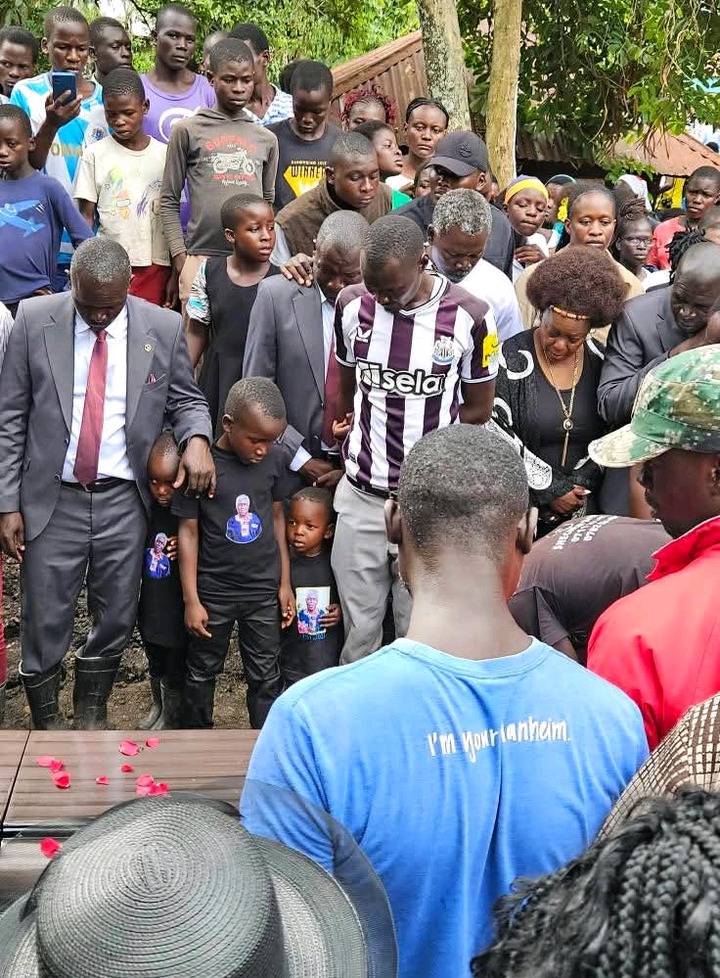
ODM MP Millie Odhiambo laid her late uncle, Absalom Oroto, to rest in Kanyada, Homabay Town Constituency.In her heartfelt tribute, MP Millie described her uncle as a towering figure of kindness, love, discipline, and hard work.

She also shared fond memories of his unique sense of humor that often struck people long after the moment had passed.

He was one of four siblings—alongside the late Suleman, Millie’s late mother, Aunty Azenath, and himself, Absalom.

Millie reflected on the strong values she learned from them, including the importance of prayer, unity among siblings, and the rewards of maintaining discipline and focus.

She acknowledged that the funeral was deeply emotional yet a fitting farewell. Despite the rain, friends and family turned up in large numbers to offer their support, something she appreciated deeply.

She extended her gratitude to everyone who showed solidarity, whether in person or in spirit, including prominent leaders such as Governor Gladys Wanga, Senator Moses Kajwang, Hon. Bensouda.Hon. Kaluma, Hon. Babu Owino, Hon. Koech, and Hon. Murungara, among others. “God bless you all. RIP Nera,” she concluded.

Separately, Millie Odhiambo recently addressed the National Assembly, urging President William Ruto to take the Ministry of Gender, Culture more seriously.

She criticized the prolonged leadership gap following the cabinet dissolution in July 2024.

Although Hanna Cheptumo was recently approved as Gender CS, Odhiambo lamented the eight-month vacuum and questioned the repeated rejection of nominees.

She stressed that the ministry should not be treated as a placeholder for political appointees but rather as a key pillar for national development.

By Nairobi

By admin

Leave a Reply

Your email address will not be published. Required fields are marked *

You missed

The United States military has conducted precision missile strikes against Islamic State (ISIS) targets in northwest Nigeria, signaling a new phase of active U.S. military engagement in West Africa. The operation, ordered by U.S. President Donald Trump on Christmas Day, involved warships firing long-range missiles from the Gulf of Guinea into Sokoto State, where ISIS-affiliated militants have increased activities in recent months. Video footage released by the U.S. Department of War shows missiles being launched from a U.S. Navy surface combatant operating at sea. Defense analysts assess that the strike likely involved Tomahawk cruise missiles fired from an Arleigh Burke-class guided-missile destroyer — a platform routinely used by the U.S. Navy for long-range precision strikes. The missiles reportedly struck at least two ISIS camps, killing multiple militants, according to a statement from the U.S. military’s Africa Command (AFRICOM). The action marks one of the first publicly acknowledged uses of sea-launched cruise missiles against targets on Nigerian soil. Following the strikes, U.S. Defense Secretary Pete Hegseth thanked the Nigerian government for its support and cooperation, adding cryptically on social media that there is “more to come…” — suggesting additional operations could follow. Nigerian officials also affirmed the strikes were conducted as part of ongoing security cooperation with the United States, emphasizing intelligence sharing and strategic coordination to target extremist groups. A Nigerian foreign ministry post described the impact as “precision hits on terrorist targets” in the northwest. The operation comes amid increased activity by Islamic State-linked groups in Nigeria — particularly the Islamic State Sahel Province (ISSP), sometimes known locally as Lakurawa. This faction has been active in northwestern states such as Sokoto and Kebbi, involved in kidnappings, killings, and attacks on security forces. The U.S. and Nigerian governments have reported conducting intelligence flights over Nigeria since late November, underscoring weeks of planning before the strike. Reuters confirmed U.S. military aircraft and surveillance efforts have been visible across the region as part of preparatory operations. U.S. authorities have framed the strikes as retaliation against militants responsible for violent attacks, including claims that extremist groups are targeting Christian communities. President Trump described the action as a powerful military response to “terrorist scum” committing atrocities, particularly against Christians — a characterization that has sparked international debate about the motivations behind the intervention. Nigerian government officials have stressed that extremist violence affects communities across religious lines and that cooperation with the U.S. aims to address broader security challenges rather than a single sectarian narrative. With President Trump’s warning of further military actions and continued joint efforts between U.S. and Nigerian forces, this strike may herald a broader counter-terrorism campaign in the region. Analysts say long-term stability will require more than kinetic operations, pointing to issues like governance, local security capacity, and socioeconomic development.