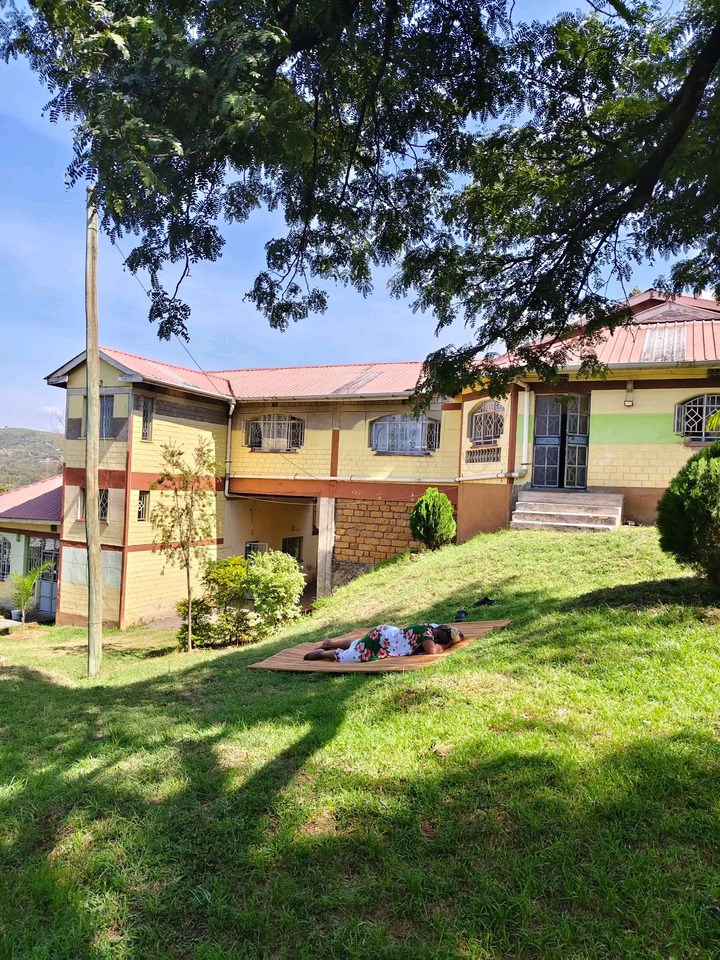
Bubbly and charming Dr. Zippora Agath Okoth, popularly known as Dr. Zippy, has once again captured the attention of Kenyans online.On Wednesday, the award-winning actress, filmmaker, and KCA University senior lecturer shared a glimpse of her parents’ village home, sparking admiration from fans and followers.

In the photos she posted, Dr. Zippy was seen relaxing outdoors on a wooden mat, face down, basking in the serene environment.

Her parents’ multi-story house, painted a warm yellow with a distinctive red roof, stood gracefully amid gently sloping green lawns.

A large leafy tree provided dappled shade, while rolling hills in the distance completed the idyllic rural scenery.

The actress, who is also a French African Young Leaders Program laureate, used the post to share candid reflections on life, love, and family.

She wrote about enjoying her father’s home, savoring simple meals like Kamongo, and dreaming of a future partner brave enough to greet her father.Zippy’s post also touched on societal expectations, playful banter about Luo men, and the humorous antics of her extended family, all of which resonated with her followers.

Fans flocked to comment, praising her authenticity, beauty, and the peaceful charm of her family estate.

Through her post, Dr. Zippy reminded Kenyans that amidst fame and accolades, there is value in returning to one’s roots, enjoying family spaces, and reflecting on personal growth.

Her blend of humor, honesty, and scenic storytelling has cemented her status as not only a talented entertainer and academic but also a relatable figure who embraces life with charm, wit, and authenticity.

By Meta

By admin

Leave a Reply

Your email address will not be published. Required fields are marked *

You missed

The United States military has conducted precision missile strikes against Islamic State (ISIS) targets in northwest Nigeria, signaling a new phase of active U.S. military engagement in West Africa. The operation, ordered by U.S. President Donald Trump on Christmas Day, involved warships firing long-range missiles from the Gulf of Guinea into Sokoto State, where ISIS-affiliated militants have increased activities in recent months. Video footage released by the U.S. Department of War shows missiles being launched from a U.S. Navy surface combatant operating at sea. Defense analysts assess that the strike likely involved Tomahawk cruise missiles fired from an Arleigh Burke-class guided-missile destroyer — a platform routinely used by the U.S. Navy for long-range precision strikes. The missiles reportedly struck at least two ISIS camps, killing multiple militants, according to a statement from the U.S. military’s Africa Command (AFRICOM). The action marks one of the first publicly acknowledged uses of sea-launched cruise missiles against targets on Nigerian soil. Following the strikes, U.S. Defense Secretary Pete Hegseth thanked the Nigerian government for its support and cooperation, adding cryptically on social media that there is “more to come…” — suggesting additional operations could follow. Nigerian officials also affirmed the strikes were conducted as part of ongoing security cooperation with the United States, emphasizing intelligence sharing and strategic coordination to target extremist groups. A Nigerian foreign ministry post described the impact as “precision hits on terrorist targets” in the northwest. The operation comes amid increased activity by Islamic State-linked groups in Nigeria — particularly the Islamic State Sahel Province (ISSP), sometimes known locally as Lakurawa. This faction has been active in northwestern states such as Sokoto and Kebbi, involved in kidnappings, killings, and attacks on security forces. The U.S. and Nigerian governments have reported conducting intelligence flights over Nigeria since late November, underscoring weeks of planning before the strike. Reuters confirmed U.S. military aircraft and surveillance efforts have been visible across the region as part of preparatory operations. U.S. authorities have framed the strikes as retaliation against militants responsible for violent attacks, including claims that extremist groups are targeting Christian communities. President Trump described the action as a powerful military response to “terrorist scum” committing atrocities, particularly against Christians — a characterization that has sparked international debate about the motivations behind the intervention. Nigerian government officials have stressed that extremist violence affects communities across religious lines and that cooperation with the U.S. aims to address broader security challenges rather than a single sectarian narrative. With President Trump’s warning of further military actions and continued joint efforts between U.S. and Nigerian forces, this strike may herald a broader counter-terrorism campaign in the region. Analysts say long-term stability will require more than kinetic operations, pointing to issues like governance, local security capacity, and socioeconomic development.