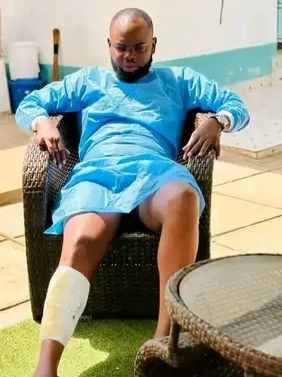
Content creator Nicki Bigfish, a popular figure known for his comedic pranking skits, has been hospitalized following a violent incident while filming one of his videos.

The incident has raised concerns about the safety of content creators, particularly those who engage in public pranks and stunts.

According to reports, Nicki Bigfish was attacked during the shooting of a prank when tensions escalated unexpectedly.

The assault resulted in injuries that required immediate medical attention, leading to his hospitalization. While details about the severity of his injuries have not been fully disclosed, sources close to the content creator indicate that he is receiving treatment and is expected to recover with proper care.

Nicki Bigfish has built a reputation for producing humorous and engaging content, often involving unsuspecting members of the public in elaborate pranks.

His videos have garnered significant attention online, attracting thousands of followers across social media platforms.

However, the nature of his work sometimes exposes him to unpredictable situations, and this latest incident highlights the potential risks involved in creating content in public spaces.

Fans and fellow content creators have expressed their concern and solidarity, sending messages wishing him a speedy recovery.

Many have also used the incident to urge caution for creators who engage in pranks, emphasizing the importance of prioritizing safety over entertainment.

The situation also sparks a broader conversation about the need for content creators to assess potential risks and take preventive measures when filming in public.

While pranks can be a source of laughter and engagement, incidents like this underscore the unpredictable nature of human interactions and the need for vigilance.

As Nicki Bigfish recovers, the incident serves as a reminder of the challenges faced by social media entertainers who push creative boundaries.

Fans are hopeful that he will return to content creation soon, albeit with increased safety precautions, and continue to bring laughter to his audience while staying protected from harm.

By Kenyans

By admin

Leave a Reply

Your email address will not be published. Required fields are marked *

You missed

The United States military has conducted precision missile strikes against Islamic State (ISIS) targets in northwest Nigeria, signaling a new phase of active U.S. military engagement in West Africa. The operation, ordered by U.S. President Donald Trump on Christmas Day, involved warships firing long-range missiles from the Gulf of Guinea into Sokoto State, where ISIS-affiliated militants have increased activities in recent months. Video footage released by the U.S. Department of War shows missiles being launched from a U.S. Navy surface combatant operating at sea. Defense analysts assess that the strike likely involved Tomahawk cruise missiles fired from an Arleigh Burke-class guided-missile destroyer — a platform routinely used by the U.S. Navy for long-range precision strikes. The missiles reportedly struck at least two ISIS camps, killing multiple militants, according to a statement from the U.S. military’s Africa Command (AFRICOM). The action marks one of the first publicly acknowledged uses of sea-launched cruise missiles against targets on Nigerian soil. Following the strikes, U.S. Defense Secretary Pete Hegseth thanked the Nigerian government for its support and cooperation, adding cryptically on social media that there is “more to come…” — suggesting additional operations could follow. Nigerian officials also affirmed the strikes were conducted as part of ongoing security cooperation with the United States, emphasizing intelligence sharing and strategic coordination to target extremist groups. A Nigerian foreign ministry post described the impact as “precision hits on terrorist targets” in the northwest. The operation comes amid increased activity by Islamic State-linked groups in Nigeria — particularly the Islamic State Sahel Province (ISSP), sometimes known locally as Lakurawa. This faction has been active in northwestern states such as Sokoto and Kebbi, involved in kidnappings, killings, and attacks on security forces. The U.S. and Nigerian governments have reported conducting intelligence flights over Nigeria since late November, underscoring weeks of planning before the strike. Reuters confirmed U.S. military aircraft and surveillance efforts have been visible across the region as part of preparatory operations. U.S. authorities have framed the strikes as retaliation against militants responsible for violent attacks, including claims that extremist groups are targeting Christian communities. President Trump described the action as a powerful military response to “terrorist scum” committing atrocities, particularly against Christians — a characterization that has sparked international debate about the motivations behind the intervention. Nigerian government officials have stressed that extremist violence affects communities across religious lines and that cooperation with the U.S. aims to address broader security challenges rather than a single sectarian narrative. With President Trump’s warning of further military actions and continued joint efforts between U.S. and Nigerian forces, this strike may herald a broader counter-terrorism campaign in the region. Analysts say long-term stability will require more than kinetic operations, pointing to issues like governance, local security capacity, and socioeconomic development.