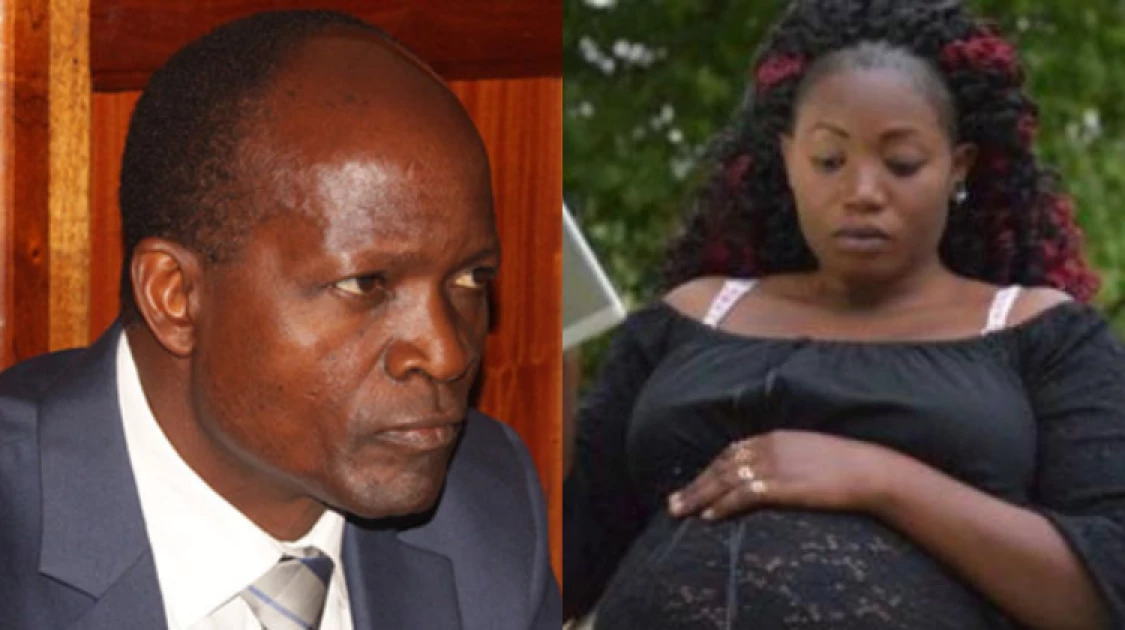
Former Migori Governor Okoth Obado has defended himself in the case where he was found to have a case to answer in the murder of the late university student Sharon Otieno.

Obado on Wednesday told court that he was transparent with affair with Sharon, had confessed to his wife and had already taken steps to end it before Sharon’s tragic death.

Obado revealed that he confessed to the affair, apologized to his wife, and assured her that the relationship with Sharon was over. He also stated that he took responsibility for the child Sharon was expecting.

In a surprising revelation, Obado said his wife had offered to give Sharon one of their houses, a gesture he declined, insisting he had no intention of marrying a second wife.

Detailing a private meeting, Obado recounted how he found his wife, a journalist, and a man identified as XYZ in a boardroom.

His wife had already been briefed about the affair in August, but XYZ—claiming to have received messages from journalist Lawrence Muller—wanted to confirm the details.

Obado said his wife stepped out briefly to make tea, allowing XYZ to share that Muller had approached him to cover the story.

“My wife was in that meeting—even when I gave them money. It was actually my wife who loaned me the Ksh.30,000 I handed over to them,” Obado said.

He described a meeting with Muller at Heron Court Hotel in Nairobi, where Muller discussed Sharon’s proposal for housing assistance in either Nairobi or Kisumu. Obado said he rejected those options and instead suggested purchasing land in Homa Bay and building a house worth Ksh.3 million.

“Muller told me Sharon refused the Homa Bay option and insisted on a 50 by 100 plot in Kisumu town. But I was clear—I only supported buying land in the rural area,” Obado said.

He further revealed that Sharon’s pregnancy-related health issues were discussed, and he promised to support her through Muller. He also arranged for her to have a medical cover.

According to Obado, Sharon had agreed to move into a rental house while waiting for her house to be built, a transition she was reportedly comfortable with.

By Citizen Digital

By admin

Leave a Reply

Your email address will not be published. Required fields are marked *

You missed

The United States military has conducted precision missile strikes against Islamic State (ISIS) targets in northwest Nigeria, signaling a new phase of active U.S. military engagement in West Africa. The operation, ordered by U.S. President Donald Trump on Christmas Day, involved warships firing long-range missiles from the Gulf of Guinea into Sokoto State, where ISIS-affiliated militants have increased activities in recent months. Video footage released by the U.S. Department of War shows missiles being launched from a U.S. Navy surface combatant operating at sea. Defense analysts assess that the strike likely involved Tomahawk cruise missiles fired from an Arleigh Burke-class guided-missile destroyer — a platform routinely used by the U.S. Navy for long-range precision strikes. The missiles reportedly struck at least two ISIS camps, killing multiple militants, according to a statement from the U.S. military’s Africa Command (AFRICOM). The action marks one of the first publicly acknowledged uses of sea-launched cruise missiles against targets on Nigerian soil. Following the strikes, U.S. Defense Secretary Pete Hegseth thanked the Nigerian government for its support and cooperation, adding cryptically on social media that there is “more to come…” — suggesting additional operations could follow. Nigerian officials also affirmed the strikes were conducted as part of ongoing security cooperation with the United States, emphasizing intelligence sharing and strategic coordination to target extremist groups. A Nigerian foreign ministry post described the impact as “precision hits on terrorist targets” in the northwest. The operation comes amid increased activity by Islamic State-linked groups in Nigeria — particularly the Islamic State Sahel Province (ISSP), sometimes known locally as Lakurawa. This faction has been active in northwestern states such as Sokoto and Kebbi, involved in kidnappings, killings, and attacks on security forces. The U.S. and Nigerian governments have reported conducting intelligence flights over Nigeria since late November, underscoring weeks of planning before the strike. Reuters confirmed U.S. military aircraft and surveillance efforts have been visible across the region as part of preparatory operations. U.S. authorities have framed the strikes as retaliation against militants responsible for violent attacks, including claims that extremist groups are targeting Christian communities. President Trump described the action as a powerful military response to “terrorist scum” committing atrocities, particularly against Christians — a characterization that has sparked international debate about the motivations behind the intervention. Nigerian government officials have stressed that extremist violence affects communities across religious lines and that cooperation with the U.S. aims to address broader security challenges rather than a single sectarian narrative. With President Trump’s warning of further military actions and continued joint efforts between U.S. and Nigerian forces, this strike may herald a broader counter-terrorism campaign in the region. Analysts say long-term stability will require more than kinetic operations, pointing to issues like governance, local security capacity, and socioeconomic development.