

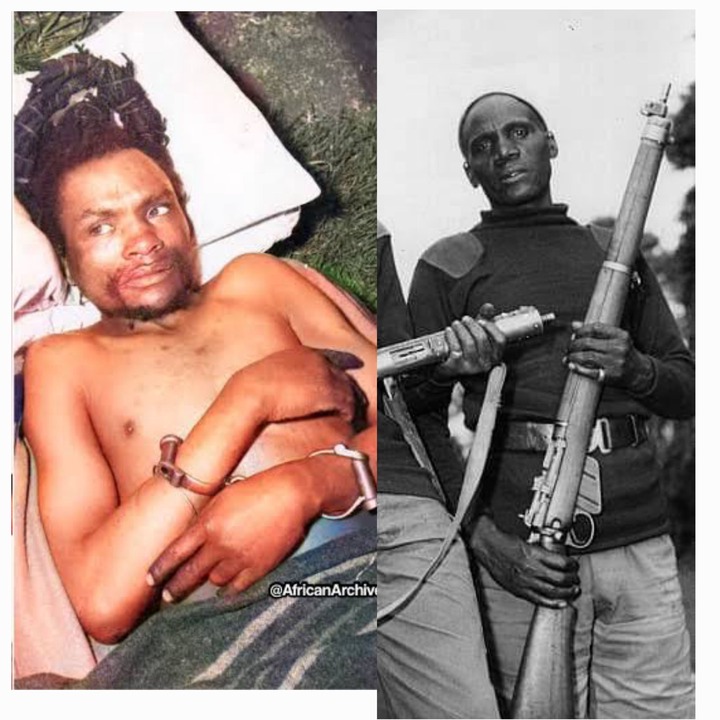
Dedan Kimathi Waciuri, a revered figure in Kenya’s fight for independence, was hanged and buried in an unmarked grave at Kamiti Maximum Prison in Nairobi. His capture remains one of the most controversial moments in Kenya’s history, largely due to the man responsible for it—police officer Ndirangu Mau.
For a bounty of Sh80,000, Ndirangu shot Dedan Kimathi at point-blank range, leading to the freedom fighter’s eventual trial and execution. The act earned Ndirangu infamy, branding him as the man who betrayed Kenya’s aspirations for independence, a title he carried with deep regret until his death in 1986 at the age of 80.
The events unfolded on October 1, 1956, when Ndirangu and 24 other officers were patrolling the Aberdare Forest in an effort to prevent Mau Mau fighters from accessing food in nearby villages.
While on patrol, Ndirangu encountered Kimathi, who was sheltering under a castor tree. Despite Kimathi’s plea to surrender, Ndirangu fired the shot that would forever change the course of Kenya’s history.
During Kimathi’s trial, Ndirangu testified that he believed he was confronting a dangerous Mau Mau terrorist and that he had ordered Kimathi to stop before firing. However, the presiding judge, Chief Justice K K O’Connor, dismissed this claim, concluding that Ndirangu had shot a defenseless Kimathi to claim the prize money offered for his capture.
The reward, PS500 (approximately Sh80,000 today), was a significant amount for Ndirangu, who was earning a mere Sh60 per month at the time. With the money, he purchased a lorry to transport passengers in Nyeri.
However, the villagers, who despised him for betraying the freedom movement, shunned the lorry and dubbed it ‘Muthimo wa Kimathi’—Kimathi’s Tibia—forever associating it with his betrayal.
A year before his death, Ndirangu expressed his remorse, admitting in an interview, “I shot Field Marshall Dedan Kimathi. I captured him, and since then, my life has been different.” The regret haunted him for the rest of his life, marking him as a man who exchanged his conscience for a fleeting monetary reward.
Kimathi’s own testimony during the trial painted a different picture of the encounter. He claimed that after identifying himself and offering to surrender, Ndirangu shot him anyway, hitting him near the groin. The court, however, ruled against Kimathi, and he was executed soon after.
Today, both men are gone, but the legacy of their encounter lingers. Ndirangu’s lorry, ‘Muthimo wa Kimathi’, still serves as a painful reminder of the cost of freedom and the fleeting nature of wealth.
By Newshub