

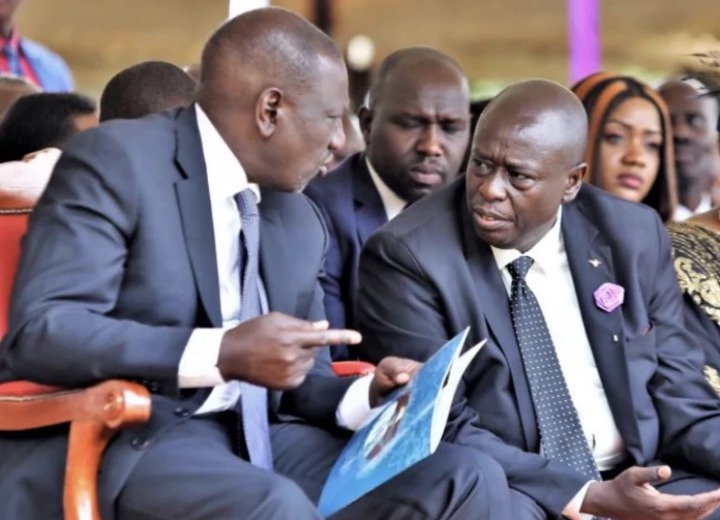
Dr. Ndonye, a senior lecturer at Kabarak University’s Department of Mass Communication, highlighted that June began with heightened political tension, attributed to the perceived discord between President William Ruto and his deputy, Rigathi Gachagua.
He pointed out that certain political interests closely monitored and fueled these tensions, hoping they would escalate into ethnic and tribal divisions.
Dr. Ndonye questioned the significance of disagreements between Dr. Ruto and Mr. Gachagua, asking whether it should be a concern. He noted that various political interests are keenly observing the implications, suggesting that if Gachagua is sidelined within the Kenya Kwanza government, it could be perceived as an attack on the entire Kikuyu tribe.
However, he argued against such broad generalizations, emphasizing that such fallacies are outdated. Even Ruto, he noted, did not solely rely on that narrative but instead sought support from a broader coalition he termed as ‘hustlers’.
He highlighted that the political landscape has evolved to intertwine with economic, social, and cultural dynamics of the 20th and 21st centuries.
Dr Ndonye added by saying that In Kenya, politics has always survived on the back of tribalism and ethnicity, but fortunately, a generation is coming up for more revolutionised way to play political card.
“The tribe we call hustlers, whose politics dominated in the 2022 elections and whose popularity Kenyan Kwanza rode to power, knows no Luo, Kikuyu, Kalenjin, Kamba, Luhya, or other tribal markers.
“They are united, first through a cord of their clamour for equality and equity in resource sharing for their survival. This is an indicator that the Kikuyu, Kalenjin, Luo, Kamba, Luhya, and other markers of the tribe are dying.” He said on the Standard.
Here is the link