

Large Scale Production
By KenyaMutua (self media writer) | 5 days ago
Can you believe how easy it is to grow watermelons with a little bit of irrigation? Watermelons are widely consumed in Kenya, where they are utilised for both culinary and culinary-related purposes. Growing crops on a massive scale is thus required to satisfy consumer appetites.
However, water is a crucial aspect in the development of this fruit. What if, though, there simply isn’t enough water where you are? So, what would you do if you were in this predicament?
Growers of watermelons face challenges unique to their industry. The environmental needs of the fruit are compounded by the time-consuming tasks of planting, weeding, and picking. When is the ideal season to plant watermelons?
All crops, including watermelons, have a specific window of opportunity for planting and harvesting. However, watermelons can be grown year-round given the correct conditions.
To flourish, watermelons need only be grown in a favourable environment. So, describe this favourable environment that you’re talking about.
First off, melons thrive at temperatures between 18 and 25 degrees Celsius. This information will help us plan the planting season more effectively.
Melons thrive in cooler regions from the beginning of May until the beginning of September.
In warm, moist regions, melons can be grown all year long. Despite the fact that watermelons are 92 percent water, they shouldn’t be grown in the wet season. Why? Let’s investigate the possibilities, some of which are presented below.
It is essential to realise that watermelon is not grown in Kenya during the rainy season or with unmonitored irrigation. Fruit’s flavour is profoundly affected by its moisture content.
So, we devised a number of techniques necessary for high-quality growth and production in order to achieve optimal irrigation. These procedures constitute the subsequent steps.
The first and most important phase in growing watermelons. Now is the time to begin daily irrigation, using only a trickle or two each time.
It should be continued until the germination stage, when the crop’s water needs shift.
Watering beginning with seed germination and ending with harvest
A large quantity of water is required at this point. Watering for longer periods is necessary, but just once or twice a day.
It is crucial to pay close attention to watermelon production between the fruiting and harvesting stages to ensure that the fruit matures properly and does not wilt as a result of irrigation.
Too much watering at this point could cause the fruit to become tasteless and brittle.
The most effective methods of watering watermelons are sprinklers and drip irrigation. More and more room is being taken up by increasingly effective and cheap devices.
Keep in mind that melons require a lot of pollinating insects, such bees and butterflies, in order to produce fruit.
By allowing for more ventilation between plants, you can stop pests from infesting your entire harvest.
Typically, watermelons can be picked from the ground between 80 and 110 days following planting.
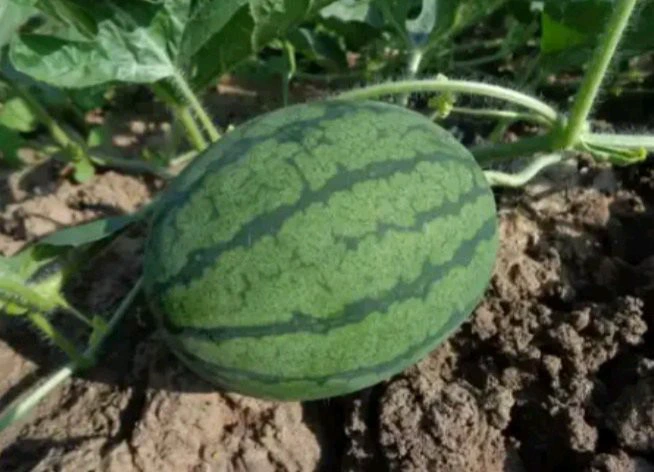
Checking the part of the fruit that touches the ground is a surefire way to determine whether or not it is ready to be eaten. The fruit is ready to be plucked when it turns a light yellow colour.
Growing melons can be really satisfying, and here’s a bonus piece of advice: after harvesting, leave the stalk in the fruit to keep it from rotting.
by: KenyaMutua