

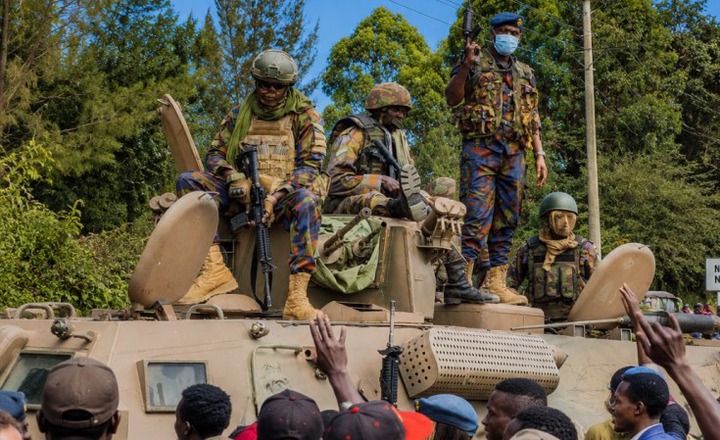
Tensions inside the central town of Nanyuki reached a boiling point on Monday, June 1, 2026, as hundreds of furious youth and local residents marched directly toward the fortified gates of the Laikipia Air Base.
The massive demonstration was triggered by shocking international disclosures that the United States government intends to redirect American citizens exposed to the deadly Ebola virus abroad to a newly constructed quarantine ward inside the high-security military installation rather than flying them back to US soil.
As the highly charged crowd advanced on the facility chanting anti-Ebola slogans, heavily armed Kenya Defence Forces (KDF) soldiers took charge of the outer perimeter, deploying massive water tankers and physical blockades to seal off all access routes and prevent a direct breach of the military base.
“We are in constant contact with the personnel inside this airbase, and our children attend schools that literally share a fence with it. If they bring Ebola here, we will all be infected.
Why is the government turning Laikipia into a dumping site for death? If this disease is not a death sentence, why aren’t these exposed Americans being flown back to their own country for treatment?” a protesting resident, Douglas Mwangi, fired to reporters at the barricades.
The sudden eruption on the streets of Laikipia County follows a highly controversial announcement by US administration officials indicating that Washington had finalized plans to set up an operational, 50-bed Ebola quarantine facility at the KDF airbase.
While US Secretary of State Marco Rubio attempted to soften the diplomatic blow by announcing a companion $13.5 million package toward Kenya’s broader public health preparedness, the revelation has instead sparked an absolute wildfire of sovereign fury and intense safety panics across East Africa.
The legal and administrative machinery has rapidly ground to a halt. Just 48 hours before the mass march, High Court Judge Patricia Nyaundi issued sweeping conservatory orders freezing the entire bilateral arrangement.
The emergency injunction—triggered by constitutional petitions filed by the Law Society of Kenya (LSK) and a prominent governance watchdog—firmly barred the state from establishing or operating any Ebola containment centers tied to the US deal.
The petitioners successfully argued before the court that Kenya’s domestic healthcare framework is fundamentally too fragile to safely absorb foreign exposures of a highly lethal virus, particularly the current virulent Bundibugyo strain active in the region, which currently lacks an approved vaccine or treatment protocol.