

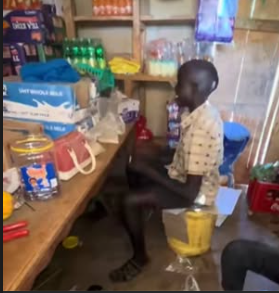
A thirteen year old boy from a rural village has drawn attention after choosing an unusual path that has left many people talking.
While his age mates attend school and worry about exams he has decided that education is not for him.
Instead he has embraced business and self employment at a very young age.
According to people who know him the boy left school after deciding he did not want what he calls the stress of learning.
He made his first bold move by selling a goat that belonged to him.
With the money he raised he opened a small shop in the village.
The shop sells basic household items and has quickly become popular among residents.
What surprised many even more is that the boy also owns a posho mill.
It is the only posho mill in the village and serves dozens of families daily.
Villagers say people come from nearby areas to grind maize and the business brings in steady income.
For a child of his age this level of responsibility is rare.
The boy says he understands business better than school.
He believes trading and machinery will give him a better life than sitting in a classroom.
He openly says he does not recognize school as part of his future and prefers running his shop and operating machines.
Reactions to his story have been mixed.
Some people admire his confidence and entrepreneurial spirit saying he shows maturity beyond his years.
They argue that talent comes in different forms and that practical skills can also lead to success.
Others are concerned about his decision to abandon school at such a young age.
Education experts warn that while business skills are important basic education provides knowledge protection and long term opportunities that are hard to replace.
Parents in the area say the case highlights the challenges facing rural education including poverty lack of motivation and limited role models.
Some believe the boy should be supported to balance both learning and business.
For now the young entrepreneur continues to focus on his shop and posho mill.
His story raises questions about education opportunity and how society should guide children who choose different paths early in life.
By Meta