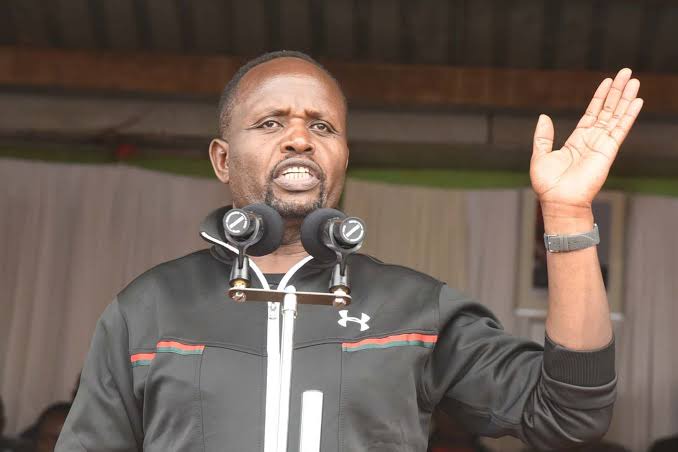
Trans Nzoia Governor George Natembeya has launched a scathing attack on President William Ruto’s administration over the handling of a long-standing community land dispute in the county, vowing financial support to affected residents and calling for urgent national intervention.

Speaking during a public engagement in Nyakinywa, Natembeya pledged KES 10 million to families displaced from what he described as community land, accusing the national government of failing to protect vulnerable citizens.

The governor’s remarks come amid heightened tension in parts of Trans Nzoia following evictions linked to contested land ownership claims.


Residents have accused state agencies of enforcing evictions without adequate consultation, compensation, or clear resettlement plans.

Natembeya argued that the manner in which the exercise was conducted violated both the spirit and letter of the Constitution, particularly provisions protecting community land rights.

Addressing residents, the governor said the land in question historically belonged to local communities and should not be arbitrarily reclassified or repossessed without due process.

He accused the national government of prioritising powerful interests at the expense of ordinary citizens, warning that unresolved land injustices remain a major trigger of conflict in the Rift Valley region.

Natembeya’s pledge of KES 10 million, he explained, is intended to provide immediate relief to affected families, including support for food, shelter, and basic necessities as longer-term solutions are pursued.

He clarified that while county governments have limited jurisdiction over land matters—which largely fall under national authority—he could not stand by as residents suffered displacement and uncertainty.

The governor also called for a comprehensive audit of land ownership in Trans Nzoia, urging the Ministry of Lands and relevant commissions to clarify boundaries, titles, and historical claims.


He stressed that sustainable peace can only be achieved through transparent processes that recognise community land rights and involve residents in decision-making.

While the national government has maintained that evictions are conducted in accordance with the law, Governor George Natembeya insisted that legality must go hand in hand with humanity and constitutional safeguards.

He urged affected residents to remain peaceful, assuring them that his administration would continue to advocate for justice through legal and political channels.

By Creatorhub

By admin

Leave a Reply

Your email address will not be published. Required fields are marked *

You missed

The United States military has conducted precision missile strikes against Islamic State (ISIS) targets in northwest Nigeria, signaling a new phase of active U.S. military engagement in West Africa. The operation, ordered by U.S. President Donald Trump on Christmas Day, involved warships firing long-range missiles from the Gulf of Guinea into Sokoto State, where ISIS-affiliated militants have increased activities in recent months. Video footage released by the U.S. Department of War shows missiles being launched from a U.S. Navy surface combatant operating at sea. Defense analysts assess that the strike likely involved Tomahawk cruise missiles fired from an Arleigh Burke-class guided-missile destroyer — a platform routinely used by the U.S. Navy for long-range precision strikes. The missiles reportedly struck at least two ISIS camps, killing multiple militants, according to a statement from the U.S. military’s Africa Command (AFRICOM). The action marks one of the first publicly acknowledged uses of sea-launched cruise missiles against targets on Nigerian soil. Following the strikes, U.S. Defense Secretary Pete Hegseth thanked the Nigerian government for its support and cooperation, adding cryptically on social media that there is “more to come…” — suggesting additional operations could follow. Nigerian officials also affirmed the strikes were conducted as part of ongoing security cooperation with the United States, emphasizing intelligence sharing and strategic coordination to target extremist groups. A Nigerian foreign ministry post described the impact as “precision hits on terrorist targets” in the northwest. The operation comes amid increased activity by Islamic State-linked groups in Nigeria — particularly the Islamic State Sahel Province (ISSP), sometimes known locally as Lakurawa. This faction has been active in northwestern states such as Sokoto and Kebbi, involved in kidnappings, killings, and attacks on security forces. The U.S. and Nigerian governments have reported conducting intelligence flights over Nigeria since late November, underscoring weeks of planning before the strike. Reuters confirmed U.S. military aircraft and surveillance efforts have been visible across the region as part of preparatory operations. U.S. authorities have framed the strikes as retaliation against militants responsible for violent attacks, including claims that extremist groups are targeting Christian communities. President Trump described the action as a powerful military response to “terrorist scum” committing atrocities, particularly against Christians — a characterization that has sparked international debate about the motivations behind the intervention. Nigerian government officials have stressed that extremist violence affects communities across religious lines and that cooperation with the U.S. aims to address broader security challenges rather than a single sectarian narrative. With President Trump’s warning of further military actions and continued joint efforts between U.S. and Nigerian forces, this strike may herald a broader counter-terrorism campaign in the region. Analysts say long-term stability will require more than kinetic operations, pointing to issues like governance, local security capacity, and socioeconomic development.