

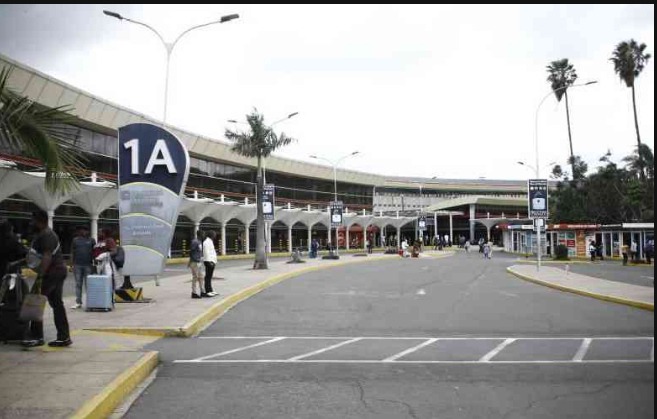
A quiet Monday morning in Nairobi turned chaotic when plainclothes officers stormed a residence in Nyayo Estate, Embakasi.
The target was a man named Moha, captured earlier on CCTV at Jomo Kenyatta International Airport’s check-in area.
His arrest, carried out in front of children and neighbours, marked the beginning of a spiraling investigation that has now drawn in law enforcement agencies from London to Nairobi.
The Directorate of Criminal Investigations (DCI) questioned Moha for hours, led by its Director and the head of the Anti-Narcotics Unit.
At the same time, the Metropolitan Police Service in London contacted Kenyan authorities, seeking clarity on the cocaine trail that allegedly passed through JKIA.
The timing of the arrest and the international interest suggested deeper links between local operatives and foreign networks.
Another suspect, Dos Santos, was seen wearing a yellow reflector jacket and escorted through Terminal 1A without interference. He spent a night in custody at the Airport Police Station before being released.
Dos Santos worked for a Kenya-based firm contracted by British Airways, raising questions about the role of ground staff in the breach. He later appeared before Isleworth Crown Court in London, where he was remanded pending trial.
The Kenya Airports Authority (KAA) responded by writing to the DCI, requesting a full probe into what has now been dubbed the “Cocaine Highway.”
However, sources revealed that key investigation files had gone missing. Some top DCI officials were unaware of the requests, and KAA’s chairman has yet to confirm or deny the claims.
Inside JKIA, staff described a senior female detective attached to a Cabinet Minister as “untouchable.”
Her badge reportedly granted unrestricted access to all airport zones, bypassing standard security protocols. This revelation, paired with silence from British Airways and the Cabinet, intensified public outrage.
Former Deputy President Rigathi Gachagua challenged the current administration, questioning how he could lead anti-drug efforts while sharing Cabinet space with alleged traffickers.
His remarks added political weight to an already volatile situation.
Security analysts warned that Kenya’s reputation as a regional aviation hub was at risk. JKIA, classified as a Category One airport, handles direct flights to major global cities.
Any downgrade by international regulators could disrupt trade, tourism, and cargo movement—especially for industries like fresh produce and flowers.
The scandal also triggered diplomatic concerns. Kenya’s role in international counter-narcotics cooperation came under scrutiny, with fears that the country could be viewed as a narco-transit state.
Analysts urged swift action, noting that the Anti-Narcotics Unit and the Criminal Investigations Office at JKIA had failed to prevent cartel infiltration.
What began as a single arrest has now exposed systemic vulnerabilities, political entanglements, and international consequences.
The winners remain elusive. The losers, for now, include Kenya’s aviation reputation, its law enforcement credibility, and the families caught in the crossfire.
By Nairobi